
Healthcare App Development Services
Our healthcare app development services cover patient apps, clinician tools, and the admin backend, EHR, payment, and device integrations behind them. We build them for digital health startups and care providers, for iOS, Android, and web as the product needs. Each build starts with the one flow a user must finish on day one, such as register, book, pay, and see a doctor. Shift.AI's testable MVP shipped in three weeks. Our production releases grow from the MVP on the same architecture.
A Healthcare App Development Company Built Around the First Release
Plus8Soft is a healthcare app development company for digital health startups, clinics, and care providers. We build healthcare mobile apps for iOS and Android, web apps for patients and staff, and medical apps for clinicians. Scoping starts with the flow a new user has to complete. For Hola Salud, a virtual care platform in Mexico, that flow was: register, pick a doctor, book, pay, and have the visit. The doctor portal, admin backend, and pharmacy integration support that flow. “Plus8Soft saved us at the earliest stage,” says Humberto Pedrero, CEO of Hola Salud.
Most of our digital health app development starts as an MVP on synthetic data, so user testing begins before vendor agreements are signed. The production release then builds on the MVP code. Shift.AI, a voice AI companion for clinicians, reached a testable MVP in three weeks.
Four decisions shape the first release, and we settle them with you in the opening weeks:
- Which privacy rules apply. Your counsel decides; we design screens, vendors, and the data model around that decision.
- How patients pay. Card, insurance, cash, or an employer. Hola Salud takes cards through Stripe and cash at Oxxo convenience stores.
- When the clinician and admin side ships. A clinician portal and an admin backend let your team manage schedules, pricing, and content without engineers.
- Which agreements and reviews start now. Vendor agreements and the health system’s security review set the launch date, so we start them in the first weeks.
For video visits and remote monitoring programs, see telemedicine platform development; for patient portals and clinician workstation apps, see patient portal development. How we handle protected health information is on our HIPAA-compliant software development page, and the full picture of our healthcare work is on the healthcare software development hub.
Healthcare Apps We Build
Most projects start as one of these app types and grow into two or three.
01
Healthcare Mobile App Development Services
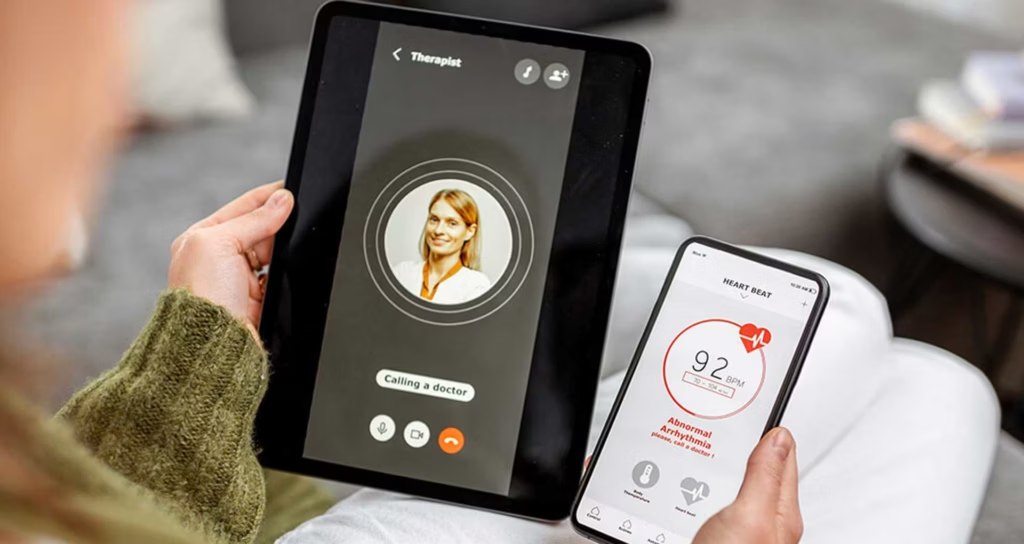
Patient apps for iOS and Android with identity-verified onboarding, booking and reminders, and data from HealthKit, Health Connect, and connected devices. By default, push notifications carry no clinical details.
01
Patient apps for iOS and Android with identity-verified onboarding, booking and reminders, and data from HealthKit, Health Connect, and connected devices. By default, push notifications carry no clinical details.
02
Medical App Development for Clinicians
Our medical app development services cover clinicians on the move: on-call and visit apps and decision-support views. We also build voice companions such as Shift.AI, which helps clinicians with the emotional side of their work. AI features are designed so a clinician reviews any output that affects care.
02
Our medical app development services cover clinicians on the move: on-call and visit apps and decision-support views. We also build voice companions such as Shift.AI, which helps clinicians with the emotional side of their work. AI features are designed so a clinician reviews any output that affects care.

03
Digital Health MVP Development
A testable build of the core flow on synthetic data (realistic test records with no real patient information), ready for user testing and investor demos in weeks. You get the build, the success criteria, and a written list of what the MVP leaves out.
03
A testable build of the core flow on synthetic data (realistic test records with no real patient information), ready for user testing and investor demos in weeks. You get the build, the success criteria, and a written list of what the MVP leaves out.
04
mHealth App Development
Our mHealth app developers build wellness, mental health, chronic-condition, and caregiver apps with structured programs, self-guided content, reminders, and escalation to a human when a user needs one. Activation, retention, and program completion are tracked from launch.
04
Our mHealth app developers build wellness, mental health, chronic-condition, and caregiver apps with structured programs, self-guided content, reminders, and escalation to a human when a user needs one. Activation, retention, and program completion are tracked from launch.

05
Connected Devices and Wearables
Patient apps that pair with Bluetooth monitors through the maker's SDK and read wearables through HealthKit, Health Connect, or the maker's API. Alerts go to the clinician on call, and where the EHR accepts them, readings arrive as structured records clinicians can chart.
05
Patient apps that pair with Bluetooth monitors through the maker's SDK and read wearables through HealthKit, Health Connect, or the maker's API. Alerts go to the clinician on call, and where the EHR accepts them, readings arrive as structured records clinicians can chart.
06
Admin and Back-Office Apps
The software behind the app: clinician onboarding and credentialing, scheduling rules, pricing, content management, claims and eligibility workflows, and reporting. Operations staff run the service from these tools.
06
The software behind the app: clinician onboarding and credentialing, scheduling rules, pricing, content management, claims and eligibility workflows, and reporting. Operations staff run the service from these tools.
Healthcare App Development Capabilities
Discovery and the First Flow
One document before design starts: who the users are, what data each screen touches, which privacy rules apply, and which vendors will see patient data. It sets the MVP scope, the vendor list, and the security review that comes later.
Native and Cross-Platform Development
We build iOS and Android apps in Swift and Kotlin, React Native, or Flutter, and web apps in Next.js. One design system across platforms, automated builds and tests, and App Store and Google Play submission with the health-data disclosures both stores ask for.
EHR and Health Data Integration
FHIR R4 and SMART on FHIR integrations for Epic, Oracle Health, and Athenahealth, plus lab and pharmacy connections. Where hospital feeds require HL7 v2, we route them through an interface engine. The goal is your app's data in the chart clinicians already use.
Privacy and Security by Default
Encryption in transit and at rest, multi-factor authentication, role-based access, tamper-evident audit logs, and a business associate agreement with every vendor that stores or processes patient data. A health system's security reviewer gets access records and logs to inspect.
Payments, Video, and Messaging
We build card, cash, and insurance payment flows, plus video visits, chat, and notifications, on vendors that sign the agreements your data requires. Payment flows carry no clinical data, and each vendor sits behind your own API so replacing one touches as little of the apps as possible.
Product Analytics Without Patient Data
We track activation, retention, and funnels from launch and design events so no patient data reaches the analytics vendor. Logging and crash reports follow the same rule.
One document before design starts: who the users are, what data each screen touches, which privacy rules apply, and which vendors will see patient data. It sets the MVP scope, the vendor list, and the security review that comes later.

Our Healthcare App Case Studies
Shift.AI

Shift.AI
Digital healthcare platform for Mexico.
We built a complete healthcare ecosystem, including a patient app, a doctor’s portal, and an admin backend, with self-registration, appointment booking, medical records, and integrated Stripe and Oxxo payments.
Hola Salud

Hola Salud
AI-powered women’s health platform.
We developed an AI platform that turns elite health experts into digital twins and reviews years of patient data in under 60 seconds, delivering risk assessments up to 10x faster and cutting time-to-care from days to minutes.
InnerPeak.AI

InnerPeak.AI
AI support tool for clinicians, built for Inclusive Health.
We built a mobile app that gives clinicians brief, trauma-informed AI support in real time, with bidirectional voice chat, guided meditation and grounding flows, and conversation memory across sessions. The MVP was delivered in 3 weeks.
InfiniHealth IPA
InfiniHealth IPA
Student mental wellness platform.
We developed a comprehensive web and mobile application that provides students and teachers with 24/7 personalized support and engaging resilience training to build essential life skills.
Flexible Developer Hiring Model
Your priorities define the way we work together — from how much control you want to the level of flexibility your project demands.
Team Augmentation
Quickly scale your workforce with skilled developers who integrate seamlessly into your in-house team, filling talent gaps and boosting productivity.
Read more
Dedicated Development Team
A whole, cross-functional team working exclusively on your project, providing end-to-end development, management, and long-term support.
Read more
Software Development Outsourcing
Delegate your entire project to our specialists and focus on business growth, while we handle development, delivery, and quality.
Read more
Why Plus8Soft?
01
Experience
Multiplied by AI
Multiplied by AI
We blend deep engineering expertise with cutting-edge AI acceleration. By integrating intelligent tools into our workflow, we don't just write code—we engineer solutions faster and with higher precision.
02
Business-First
Transparency
Transparency
We look beyond the ticket. Our team operates with hyper-transparency, treating your budget and goals as our own. We align technical decisions with your business strategy to create real, measurable value.
03
Committed to
Overdelivery
Overdelivery
Meeting requirements is our baseline; exceeding them is our culture. Whether it's optimizing performance, refining UX, or anticipating future scalability, we consistently go the extra mile.
Healthcare App Development Services FAQ
How much does healthcare app development cost with Plus8Soft?
A testable MVP on synthetic data is the smallest engagement and is priced after a scoping call. On an existing EHR, a first app costs $40,000 to $100,000. A two-sided platform with a clinician portal, an admin backend, and bidirectional EHR sync runs $120,000 to $250,000. Integrated platforms with AI features start at $250,000. Security work and testing are included in those ranges; subscription fees for hosting, video, and payment services are paid to those providers directly. We plan for 15% to 20% of build cost per year for maintenance and platform updates.
How long does it take you to build a healthcare app?
A testable MVP can ship in weeks. A first production release that handles patient data typically takes 3 to 6 months. A two-sided platform with clinician and admin tools takes 5 to 7 months, and integrated platforms with AI features 7 to 9 months or more. Vendor agreements, the health system's security review, and security testing usually set the pace.
How do you build a digital health MVP for a startup?
We start with the one flow that proves the product works for its first users and write down what the MVP leaves out. The build runs on synthetic data, so user testing and investor demos can start before vendor agreements and production infrastructure are in place. Architecture and vendor choices are made for production from day one. The MVP's code and data model then carry into the first production release rather than being rebuilt.
Which mobile app development option do you recommend for a digital health startup?
The one that matches what the app needs from the device. Native Swift and Kotlin when the product depends on Bluetooth peripherals, HealthKit or Health Connect, background sensing, or camera-heavy features. React Native or Flutter when the product is forms, video, and content and one team maintains both platforms. Many startups release first on the platform most of their early users carry and add the second one next.
How do you integrate a healthcare app with Epic and other EHRs?
Through the EHR vendor's developer program. FHIR R4 APIs read records and write back where the EHR supports it, and SMART on FHIR launches the app inside the clinician's EHR session. Oracle Health and Athenahealth follow the same pattern with their own programs. Older HL7 v2 feeds, routed through integration middleware called an interface engine, cover data the FHIR APIs do not expose. Security reviews by the health system and, where required, the EHR vendor usually set the timeline. We start both in the first weeks.
How do you connect remote patient monitoring devices to an app?
We connect Bluetooth devices to the patient's phone through the manufacturer's SDK or standard Bluetooth health profiles. Wearables connect through HealthKit, Health Connect, or the wearable maker's API, and cellular-connected monitors through the device vendor's cloud API. Readings are validated, stored, and checked against thresholds the care team sets. Alerts go to the right clinician, and readings reach the EHR as structured records where the EHR accepts them.
How do you handle HIPAA and patient data in the apps you build?
We keep patient data out of systems that do not need it. MVP builds and demos use synthetic data. Push notifications, analytics events, and payment flows carry no clinical data. Whether HIPAA, the FTC Health Breach Notification Rule, or state health-privacy laws apply is your counsel's call, and we scope the architecture to that decision. Our HIPAA-compliant software development page lists the full set of deliverables, including business associate agreements with each vendor and the risk analysis.
What tech stack do you use for healthcare apps?
It depends on the device, the integrations, and who maintains the code after launch. A typical build uses Swift and Kotlin, React Native, or Flutter for mobile, Next.js for web, and Node.js services. Data sits in PostgreSQL with patient data isolated and encrypted, and FHIR is the exchange format. EHRs connect through FHIR R4 and SMART on FHIR, and monitoring devices through the maker's SDK, HealthKit, or Health Connect. Where HIPAA applies, hosting runs on AWS, Azure, or Google Cloud under the provider's business associate agreement, using only the services it covers.