
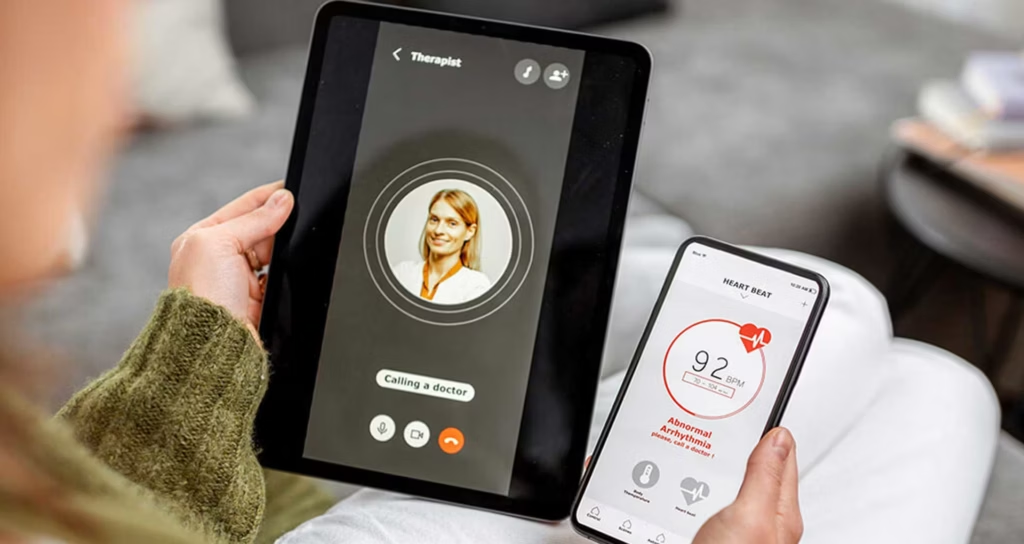
Telemedicine Platform Development
We build telemedicine platforms that clinics and digital health companies run for years: patient and provider apps, video that meets HIPAA, scheduling, e-prescribing, payments, and EHR integration. A focused first version ships in 3 to 6 months.
Telemedicine Platforms Built Around What Actually Breaks Them
Telemedicine is a standard channel now: according to the National Center for Health Statistics, 80.0% of office-based physicians used it in 2024. The buyers of a telemedicine platform today already have a video link that works. What they need is scheduling, intake, prescribing, payments, records, and follow-up in one product that clinicians will use daily and that passes a security review.
We have built that on both sides of the visit. For Hola Salud, a digital health platform for weight management in Mexico, the product covers patient onboarding, clinician visits, medication plans, and follow-up in one flow. For Shift.AI we shipped the clinician side: a voice-based AI companion with conversation memory across sessions, as a testable MVP in three weeks. For Revvel, an AI health platform that analyses multi-year medical records in under 60 seconds.
Six things break telemedicine platforms in practice, and each one shapes how we build:
- Video that fails on real networks. We use a vendor video layer under a signed business associate agreement, test it on the connections and devices patients actually have, and build an audio fallback into every visit.
- The provider side as an afterthought. Clinicians get schedule, notes, orders, and the visit in one screen, designed before the patient app, because a platform doctors avoid does not get used.
- Double entry with the EHR. Visits, notes, and orders land in the system of record through HL7 v2 and FHIR R4, so nobody retypes the encounter.
- Payments and eligibility bolted on late. Card on file, insurance eligibility checks, refunds, and receipts are part of the booking flow, not a separate system.
- The white-label ceiling. Rented platforms get you live fast and stop where the vendor stops. We build the orchestration layer so vendors can be swapped and features added without a rebuild.
- Compliance done at the end. HIPAA controls, audit logs, and vendor agreements are in the first sprint, so the security review at the end has nothing to find.
For a detailed breakdown of scope and pricing, see our guides on what goes into a telemedicine build and telemedicine app development cost; the regulatory side is covered in our healthcare app development guide.
Telemedicine Solutions We Build
Six product types cover most telemedicine engagements. Each has a different user, a different regulatory lane, and a different integration surface, and we scope them separately.
01
Virtual Care Platforms
Patient app, provider portal, and admin backend in one product: booking, intake forms, video and audio visits, notes, e-prescribing, and payments. The standard build for clinics, telehealth startups, and employer health programs.
01
Patient app, provider portal, and admin backend in one product: booking, intake forms, video and audio visits, notes, e-prescribing, and payments. The standard build for clinics, telehealth startups, and employer health programs.
02
Specialty Telehealth Products
Weight management, behavioural health, dermatology, chronic care. Programs with a defined care pathway, recurring visits, medication management, and outcome tracking, built around the clinical workflow rather than a generic visit.
02
Weight management, behavioural health, dermatology, chronic care. Programs with a defined care pathway, recurring visits, medication management, and outcome tracking, built around the clinical workflow rather than a generic visit.
03
Remote Patient Monitoring
Device data from connected scales, glucometers, blood pressure cuffs, and wearables, with threshold alerts, clinician dashboards, and billing support for RPM codes. Data flows land in the record, not in a separate silo.
03
Device data from connected scales, glucometers, blood pressure cuffs, and wearables, with threshold alerts, clinician dashboards, and billing support for RPM codes. Data flows land in the record, not in a separate silo.

04
Asynchronous and Store-and-Forward
Photo and questionnaire based consultations for dermatology, urgent care, and follow-ups. Queue management for clinicians, structured intake for patients, and turnaround tracking that keeps the service level visible.
04
Photo and questionnaire based consultations for dermatology, urgent care, and follow-ups. Queue management for clinicians, structured intake for patients, and turnaround tracking that keeps the service level visible.
05
EHR-Integrated Telehealth
Visits that read and write to Epic, Cerner, athenahealth, or eClinicalWorks through HL7 v2 and FHIR R4. Scheduling, encounter notes, and orders stay in the system of record; the platform adds the channel, not a second chart.
05
Visits that read and write to Epic, Cerner, athenahealth, or eClinicalWorks through HL7 v2 and FHIR R4. Scheduling, encounter notes, and orders stay in the system of record; the platform adds the channel, not a second chart.

06
AI Features Inside the Visit
Ambient documentation, pre-visit triage, patient-facing assistants, and post-visit summaries, scoped so the product stays outside the FDA device definition unless that is the plan. Model outputs are logged, reviewable, and never the last word on a clinical decision.
06
Ambient documentation, pre-visit triage, patient-facing assistants, and post-visit summaries, scoped so the product stays outside the FDA device definition unless that is the plan. Model outputs are logged, reviewable, and never the last word on a clinical decision.
What Goes Into a Telemedicine Platform
HIPAA-Ready Architecture
Encryption at rest and in transit, role-based access, immutable audit logs, session controls, and a signed business associate agreement with every vendor that touches protected health information. Designed to the current Security Rule and ready for the proposed update.
Video and Audio Infrastructure
A vendor video layer under a business associate agreement for the first years, tested on the networks and devices patients actually use, with an audio fallback built into every visit. Usage-based pricing stays small at clinic volumes; we plan the migration path to self-hosting from day one for the moment volume justifies it.
Scheduling, Intake, and Payments
Provider availability across time zones, patient self-booking, waitlists, reminders, consent capture, structured intake, insurance eligibility checks, and card-on-file payments through a PCI-compliant processor.
E-Prescribing and Pharmacy Integration
Surescripts-certified e-prescribing through a partner, controlled-substance workflows aligned with the DEA's telemedicine flexibilities, and pharmacy routing that keeps the prescription history in the patient record.
EHR and Data Integration
HL7 v2 feeds for ADT and scheduling, FHIR R4 APIs for patient, encounter, and observation resources, and bulk export where the EHR allows it. Integrations with Epic, Cerner, Athenahealth, and eClinicalWorks. Our guide to EHR integration covers what each interface costs and how long it takes.
Compliance Beyond HIPAA
State licensure and interstate compact checks at booking, the FTC Health Breach Notification Rule for products outside HIPAA, GDPR for EU patients, and accessibility to WCAG 2.2 AA so the platform passes procurement reviews without rework.
Encryption at rest and in transit, role-based access, immutable audit logs, session controls, and a signed business associate agreement with every vendor that touches protected health information. Designed to the current Security Rule and ready for the proposed update.

Case Studies
Hola Salud

Hola Salud
Digital healthcare platform for Mexico.
We built a complete healthcare ecosystem, including a patient app, a doctor’s portal, and an admin backend, with self-registration, appointment booking, medical records, and integrated Stripe and Oxxo payments.
Revvel

Revvel
AI-powered women’s health platform.
We developed an AI platform that turns elite health experts into digital twins and reviews years of patient data in under 60 seconds, delivering risk assessments up to 10x faster and cutting time-to-care from days to minutes.
InfiniHealth IPA

InfiniHealth IPA
Medical claims automation for a US healthcare IPA.
We built an internal platform that replaces spreadsheet-driven claims work with an automated pipeline: payer CSV imports with upsert logic, automatic validation of paid amounts against provider contracts, dispute tracking, payment batching, and EOP generation.
Shift.AI

Shift.AI
AI support tool for clinicians, built for Inclusive Health.
We built a mobile app that gives clinicians brief, trauma-informed AI support in real time, with bidirectional voice chat, guided meditation and grounding flows, and conversation memory across sessions. The MVP was delivered in 3 weeks.
Merz TX

Merz TX
Digital ecosystem for a pharmaceutical company’s medical practice tools.
We built a multi-platform ecosystem across Web, iOS, and Android that gives clinicians instant access to verified pharmaceutical knowledge, with brand learning academies, QR-based drug authentication, interactive diagnostic scales, and full CRM integration across seven brands.
Flexible Developer Hiring Model
Your priorities define the way we work together — from how much control you want to the level of flexibility your project demands.
Team Augmentation
Quickly scale your workforce with skilled developers who integrate seamlessly into your in-house team, filling talent gaps and boosting productivity.
Read more
Dedicated Development Team
A whole, cross-functional team working exclusively on your project, providing end-to-end development, management, and long-term support.
Read more
Software Development Outsourcing
Delegate your entire project to our specialists and focus on business growth, while we handle development, delivery, and quality.
Read more
Why Plus8Soft?
01
Experience
Multiplied by AI
Multiplied by AI
We blend deep engineering expertise with cutting-edge AI acceleration. By integrating intelligent tools into our workflow, we don't just write code—we engineer solutions faster and with higher precision.
02
Business-First
Transparency
Transparency
We look beyond the ticket. Our team operates with hyper-transparency, treating your budget and goals as our own. We align technical decisions with your business strategy to create real, measurable value.
03
Committed to
Overdelivery
Overdelivery
Meeting requirements is our baseline; exceeding them is our culture. Whether it's optimizing performance, refining UX, or anticipating future scalability, we consistently go the extra mile.
Telemedicine Platform Development: Frequently Asked Questions
How much does telemedicine platform development cost?
A single patient app on a vendor video API with scheduling and payments costs $40,000 to $100,000. Patient and provider portals with an admin backend, pharmacy and payment integration, and HIPAA architecture run $120,000 to $250,000. Add EHR integration over HL7 or FHIR, AI triage or documentation, and multi-region compliance, and the range starts at $250,000. Budget 15% to 20% of build cost per year for maintenance.
How long does it take to build a telemedicine platform?
A focused first version ships in 3 to 6 months. Adding a provider portal, e-prescribing, and EHR integration extends the timeline to 6 to 9 months, mostly on the integration side, because each EHR interface has its own certification and testing cycle.
Should we build our own video or use a vendor?
Use a vendor with a signed business associate agreement for the first years. At clinic volumes, usage-based video fees are a small line next to engineering and compliance, and the vendor carries the device and browser coverage. Self-hosting starts to make sense only at very high monthly volumes, so we build the platform so the video layer can be swapped when that point arrives, without touching the rest of the product.
What does HIPAA require from a telemedicine platform?
Under the current Security Rule: encryption in transit and at rest, access controls, audit logs, breach notification, and business associate agreements with every vendor handling protected health information. The proposed update from December 2024 would make MFA, encryption, and annual asset inventories mandatory, but it remains a proposal; we design to it now so the platform does not need rework when it lands.
Can our platform support prescribing controlled substances?
Yes. We build the prescribing workflow to the DEA's current telemedicine rules for controlled substances and to the special registration framework the agency has proposed, and we track rule changes so the workflow adapts when they land, without a rebuild.
Can we start on a white-label platform and move to a custom build later?
Yes, and many clients do. White-label gets you live in weeks and shows which features patients and clinicians actually use. The move to custom usually comes when you need an integration or a workflow the vendor does not support. We plan the migration so patient records, scheduling history, and payments carry over without a gap in service.
Can the platform integrate with our EHR?
Yes. We integrate with Epic, Cerner, Athenahealth, eClinicalWorks, and others through HL7 v2 for ADT and scheduling feeds and FHIR R4 for patient, encounter, and observation data. Read-only access is the fastest path; bidirectional sync and event feeds take longer and are scoped separately.