Healthcare App Development in 2026: Regulatory Lanes, Architecture, Cost, and What Ships First

The Question Every Healthcare App Starts With
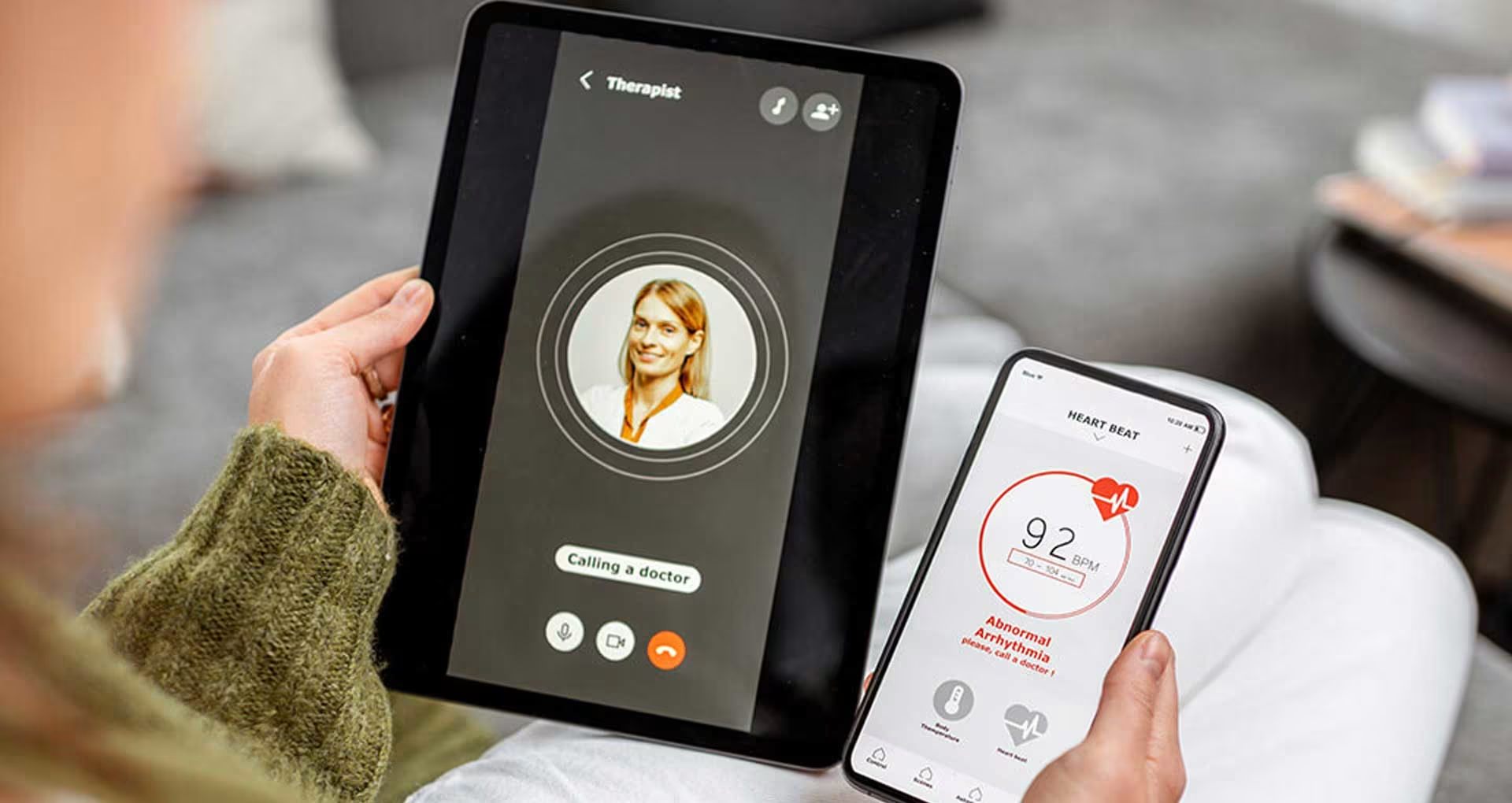
Healthcare app development is the design and engineering of software that collects, stores, or acts on health data: patient apps for telehealth and chronic care, clinician tools, operational systems for scheduling and claims, and companion apps for connected devices. In the United States the build is shaped by which of three regulatory lanes the product falls into (HIPAA, the FTC Health Breach Notification Rule, or FDA device rules) and by the integration work needed to read from electronic health records (EHR). A working first version typically costs $40,000 to $100,000 and ships in three to four months; a two-sided platform with an admin backend and integrations runs $120,000 to $250,000; products with EHR interfaces and AI features start at $250,000.
The market has moved past the pandemic spike. According to the National Center for Health Statistics (June 2026), 80.0% of office-based physicians used telemedicine in 2024, down from 86.5% in 2021, and in non-metropolitan areas the share fell to 60.9%. Demand consolidated around products that fit clinical workflow and reimbursement. On the patient side, CDC data for July to December 2022 shows 41.5% of adults communicated with a doctor’s office online and 46.1% looked up test results. The buyer of a healthcare app in 2026 already has a portal. The question is what the new product does that the portal does not.
This guide covers the decisions in the order they come up on a real build: which regulatory lane you are in, how the app will get clinical data, what an audit-ready architecture looks like, where AI is allowed without turning the product into a medical device, and what each stage costs.
Types of Healthcare Apps, With the Builds Behind Them
Telehealth, weight management, chronic-condition programs, medication adherence. The patient books, pays, sees a clinician, and receives a prescription in the same app. Hola Salud, a Mexican virtual care platform we built, pairs a patient app with a doctor portal, an admin backend, and pharmacy integration, and takes payment by card through Stripe or in cash through Oxxo convenience stores.
Structured programs, self-guided content, and escalation to a human. Engagement mechanics decide whether the product works at all. For InnerPeak.AI we built a web and mobile platform giving students and teachers round-the-clock personalized support and resilience training.
Scheduling, clinical notes, e-prescribing, decision support, and voice assistants that cut documentation time. Shift.AI, a voice companion for clinicians with conversation memory across sessions, shipped as a three-week MVP.
Claims processing, eligibility checks, provider credentialing, reporting. The least visible category and often the fastest payback. For InfiniHealth IPA we replaced a spreadsheet-based claims workflow with an automated processing platform.
Products for the people around the patient: family caregivers, support groups, care coordinators. Memini combines medical guidance, caregiving resources, and community in one dementia-support ecosystem.
Companion apps for wearables and home devices. Since January 2026 the FDA treats some non-invasive wearables that estimate blood pressure, oxygen saturation, or glucose as general wellness products when they are marketed for wellness, which moves a whole class of companion apps out of device regulation.
Which Regulatory Lane Are You In
Most guides start with features. The first decision on a real healthcare build is which regulator you answer to, because it sets the data model, the vendor list, and the launch checklist. HIPAA covers protected health information (PHI) held by providers and the vendors working for them; the FTC and the FDA cover the rest. The table gives the short version and the notes below fill in the detail.
HIPAA in practice. A telehealth app run by a clinic, a patient portal, or a claims system sits here, as does any vendor that handles PHI on a covered entity’s behalf. Breach notification is due within 60 days. The proposed Security Rule update adds mandatory multi-factor authentication (MFA), encryption at rest and in transit, a technology asset inventory, and 72-hour restoration procedures.
FTC in practice. The rule defines a breach to include unauthorized disclosure, such as passing data to an advertising platform without permission, so consent flows and a data-sharing inventory become launch requirements rather than legal paperwork. Notice to the FTC is required when 500 or more people are affected.
FDA in practice. Sepsis or stroke detection, automatic interventions, and image analysis are device functions. Since January 2026, single-recommendation clinical decision support and non-invasive wellness wearables can fall outside device regulation when they meet the FDA’s criteria.
Lanes overlap. A weight-management app sold to employers may be a business associate under one contract and a consumer product under another. Decide the lane per data flow before the data model is fixed: retrofitting PHI segmentation after launch is the most expensive change we see. Sources: HHS HIPAA Security Rule notice of proposed rulemaking, NPRM (December 2024), FTC final rule on the Health Breach Notification Rule (April 2024), FDA General Wellness guidance and FDA Clinical Decision Support guidance (both January 2026).
Interoperability: Getting Clinical Data In and Out
Most healthcare apps need data that lives in an electronic health record (EHR): problem lists, medications, lab results, appointments. Under the 21st Century Cures Act, certified EHR systems must expose a standardized Fast Healthcare Interoperability Resources (FHIR) R4 read API, so pulling patient data into your app is a scoped, predictable job. Writing data back is at each vendor’s discretion and runs through their own programs and timelines, which is why the write half of an integration usually becomes the larger part of the project. We covered the mechanics, vendor differences, and cost ranges in EHR Integration: HL7 v2 vs FHIR R4.
Enforcement is active. At HIMSS26 in March 2026, the Assistant Secretary for Technology Policy confirmed that notices had gone out to certified health IT developers about API nonconformity, that HHS had received more than 1,500 information-blocking complaints, and that penalties run up to $1 million per violation. For an app team the practical meaning is simple: a hospital or EHR vendor that refuses reasonable API access now has a regulatory problem, and your integration plan can assume the read API exists.
Plan for three connection patterns: SMART on FHIR for launching inside the clinician’s EHR session, a standalone FHIR client with patient-mediated OAuth for consumer apps, and HL7 v2 feeds where a hospital still pushes ADT (admit, discharge, transfer) events the old way. Scope each per vendor. Epic, Oracle Health, athenahealth, and the smaller vendors document their APIs differently and approve apps on different timelines.
Architecture That Survives an Audit
Classify every field at design time and keep PHI in its own services and storage with separate access policies. A clear boundary shrinks the audit scope and lets marketing, analytics, and support tools run on de-identified data.
Multi-factor authentication for every workforce and clinician account, role-based access with least privilege, and session controls that fit clinical reality (a nurse switching stations dozens of times a shift). The proposed HIPAA Security Rule update makes MFA mandatory with limited exceptions.
Log every access to a record, including reads, with actor, time, and purpose. Store logs immutably and for the retention period your lane requires. Investigators ask for this first after an incident.
Encrypt at rest and in transit by default, manage keys in a cloud key management service with rotation, and never ship credentials inside a mobile build. The NPRM proposes encryption as a requirement rather than an addressable specification.
Every service that touches PHI (video, messaging, cloud, analytics, AI APIs) needs a business associate agreement and a place in your technology asset inventory. The NPRM proposes annual written verification of business associate safeguards, so the inventory is a living document.
Backups tested against a 72-hour restoration target, which the NPRM proposes as a written procedure. IBM’s Cost of a Data Breach Report 2026 (July 2026) puts the average healthcare breach at $6.64 million, still the highest of any industry, and the Change Healthcare incident reached approximately 192.7 million individuals by HHS’s July 2025 count. Restore time is a product feature.
AI in Healthcare Apps: What Ships Without Device Status
Under the revised CDS guidance, software that gives a single clinically appropriate recommendation, or a risk score, can qualify as non-device clinical decision support (CDS) when the clinician can review its basis and the decision is not time-critical. Sepsis alerts, stroke detection, and image analysis remain devices.
Ambient note-taking, after-visit summaries, and voice assistants for clinicians sit outside device regulation when they do not drive a clinical decision on their own. Shift.AI is an example: a voice companion supporting clinicians themselves, built on retrieval-augmented generation with conversation memory.
Intake triage, symptom explanation, and navigation chatbots. The design rule: ground answers in your own approved content, log every response, and route anything resembling a diagnosis to a human. Under the FTC lane, chat transcripts are health data.
Under the General Wellness guidance, non-invasive sensing that estimates blood pressure, oxygen saturation, or glucose can be marketed as wellness when it is not intended to diagnose or treat and does not substitute for a cleared device. Values that mimic clinical measurements still need validation.
Model outputs sent to a third-party API are a PHI disclosure unless the vendor signs a BAA and the data is minimized. Prompt logs are records. Evaluate, then automate. Our AI integration practice starts with an evaluation suite before any model touches production data.
Build Sequence: From MVP to a Platform
The order of work matters more than the stack. A sequence that has held up across our healthcare projects:
- Decide the lane and the data flows. One page: who the users are, what data each screen touches, which lane each flow falls into, which vendors see PHI. This page becomes the audit scope.
- Ship the narrowest complete loop. For Hola Salud that loop was: patient registers, picks a doctor, books, pays, has the visit. The client needed to serve patients who pay in cash, so the app takes cards through Stripe and cash through Oxxo convenience stores. One platform first, native code where the device matters.
- Add the second side. A doctor portal that replaces the tools clinicians already juggle: one dashboard for patients, schedule, and online appointments.
- Build the admin backend before scale. Approving doctors, batch-updating specialties, changing pricing, managing documents, all without an engineer. For an early-stage company this is the difference between a product and a business.
- Integrate. Pharmacies, labs, EHRs, payers. Each integration is its own scoped project with its own vendor timeline.
- Layer AI on measured workflows. Once you know where clinicians spend time, automate that. The three-week Shift.AI MVP started with one workflow, difficult conversations, and a clear evaluation of the assistant’s answers.
Humberto Pedrero, CEO of Hola Salud, described the early phase this way: “Plus8Soft saved us at the earliest stage. They prioritized tasks and allocated resources strategically.” Prioritization is the product decision; the code follows it.
“Every healthcare app we have shipped had its regulatory lane decided before the first sprint. When the lane gets decided after the data model, the rework costs more than the model did,” says Evgeniy Zhdanov, CEO of Plus8Soft.
Tech Stack and Integration Choices
Stacks vary less than vendors claim. The lane, the integrations, and who will maintain the code decide the choice. Patterns that have worked:
Mobile. Native Swift and Kotlin when the app talks to device hardware, Bluetooth peripherals, or HealthKit and Health Connect; React Native or Flutter when the product is forms, video, and content and the team is small. Hola Salud shipped native iOS and Android with a Next.js web app and a Node.js backend on PostgreSQL. We compared the cross-platform options in React Native vs Flutter.
Backend and data. A relational database for clinical and billing records, with PHI tables isolated and encrypted; an event bus for ADT and appointment events; FHIR resources as the exchange format even when internal storage differs; object storage for documents and imaging with per-object encryption.
Video, messaging, payments. Buy video and messaging from vendors that sign a BAA (Twilio, Vonage, and their peers) and keep them behind your own API so a vendor swap does not touch the clients. Payment processors such as Stripe operate under HIPAA’s payment-processing exemption rather than a BAA, so keep clinical details out of payment metadata.
Cloud and DevOps. AWS, Azure, and Google Cloud all offer HIPAA-eligible services under a BAA. The eligible list is service-specific, so infrastructure-as-code should only provision from it. Secrets in a managed vault, CI with dependency and container scanning, infrastructure changes reviewed like code. The practices are the ones in our DevSecOps guide; in healthcare the audit trail of the pipeline itself becomes evidence.
Observability. Logs and traces scrubbed of PHI before they reach a third-party monitoring tool, or a BAA with that tool. Teams get this wrong more often than any encryption setting.
Healthcare App Development Cost and Timeline
The ranges below are our own estimates for a senior blended team and align with our telemedicine cost breakdown. Published price guides for healthcare apps tend to cross-cite one another, so treat any single figure, including ours, as a starting point for a scoped estimate.
What moves a project between rows: the MVP assumes a minimal custom backend; the two-sided platform adds role-based access and analytics on de-identified data; the integrated tier adds claims integration, penetration testing, and SOC 2 or HITRUST readiness. Budget 15 to 20 percent of the build cost per year for maintenance, monitoring, dependency updates, and the compliance work the NPRM will require (annual penetration tests, six-month vulnerability scans, inventory refresh). Onshore-only senior teams in the US or EU can run several times higher for the same scope. For a figure tied to your team composition, location, and duration, use the project cost calculator.
Choosing a Healthcare Development Partner
A partner who has shipped under HIPAA, under the FTC rule, and under FDA scrutiny will ask about your data flows in the first call. Silence on the lane question is the signal.
Ask to see a sample data-flow map, a BAA they have signed as a business associate, and how they scrub PHI from logs. A vendor with these ready has done it before.
EHR vendor app approvals, pharmacy and lab connections, payment providers with BAAs. Each one you do not have to build is weeks saved.
A dedicated team for a platform build, augmentation for a company with its own product leadership, full delivery for a founder without a technical team. Our healthcare development practice runs all three.
Named case studies with named clients. Where we could not name a client, we say so. We also published an analysis of the healthcare development companies a buyer is likely to shortlist, methodology included.
Common Mistakes in Healthcare App Development
Most direct-to-consumer health apps sit under the FTC rule, where sharing data with an ad SDK counts as a breach. Teams add HIPAA language to a privacy policy and skip the consent flow the FTC lane demands.
Audit logs, PHI segmentation, and vendor inventories bolted on in the last sprint cost multiples of building them in the first. Every retrofit we have done was more expensive than the original feature.
FHIR read access is mandated. Write access depends on each vendor’s program. Confirm the write program, sandbox access, and approval timeline before committing a delivery date.
When pricing, specialties, and provider approvals need an engineer, operations stall. The admin panel is the screen nobody demos and the one the business runs on.
A model that answers well in a demo and unpredictably in production is a liability in healthcare. Measure before and after, log every output, and keep a human in the loop for anything near a clinical decision.
Crash reporters, analytics SDKs, and monitoring agents receive full payloads by default. Scrub before sending or sign a BAA with the tool vendor. Regulators treat this as a disclosure.
Healthcare App Development FAQ
$40,000 to $100,000 for a single-platform MVP, $120,000 to $250,000 for a two-sided platform with an admin backend, and $250,000 to $400,000 or more when EHR integration and AI are in scope. Plan 15 to 20 percent of the build cost per year for maintenance and compliance.
Three to four months for an MVP, five to seven for a platform with two portals and integrations, and seven to nine months or more once EHR interfaces and AI features are included. EHR vendor approval timelines are the usual reason a schedule slips, so start them in parallel with the build.
Only if you are a covered entity or handle protected health information for one under a business associate agreement. A consumer wellness or symptom-tracking app without a provider relationship usually falls under the FTC Health Breach Notification Rule instead, which has its own 60-day notification and consent-related obligations.
HHS published a proposed Security Rule update in December 2024 that would make multi-factor authentication, encryption, a technology asset inventory, annual penetration testing, six-month vulnerability scans, and 72-hour restoration procedures mandatory, and would remove the addressable category. The final rule has been pushed to a mid-2027 target, so build to the proposal now rather than waiting for it.
When it diagnoses, treats, or drives a time-critical clinical decision: analyzing images, detecting sepsis or stroke, or triggering an intervention. The FDA’s January 2026 guidance leaves single-recommendation decision support and non-invasive wellness wearables outside device regulation when they meet its criteria.
Yes, with conditions. The API vendor must sign a business associate agreement if PHI is sent, the data sent should be minimized, prompts and outputs must be logged as records, and anything that resembles a diagnosis needs a human review path. Build an evaluation set before production.
Through the FHIR R4 read APIs that certified EHRs must offer under the Cures Act, using SMART on FHIR for in-EHR launch or patient-mediated OAuth for standalone apps. Write access depends on each vendor’s program. Our EHR integration guide covers the vendor-by-vendor differences and timelines.