The Future of Cloud Repatriation: Why Enterprises Are Bringing Their Data Home

How profitable is this?
Dropbox saved $75 million over two years by moving off AWS. 37signals cut their cloud bill from $3.2 million to $1.3 million annually — and projects over $10 million in savings over five years. These aren’t hypothetical scenarios. They’re public numbers from S-1 filings and company blogs.
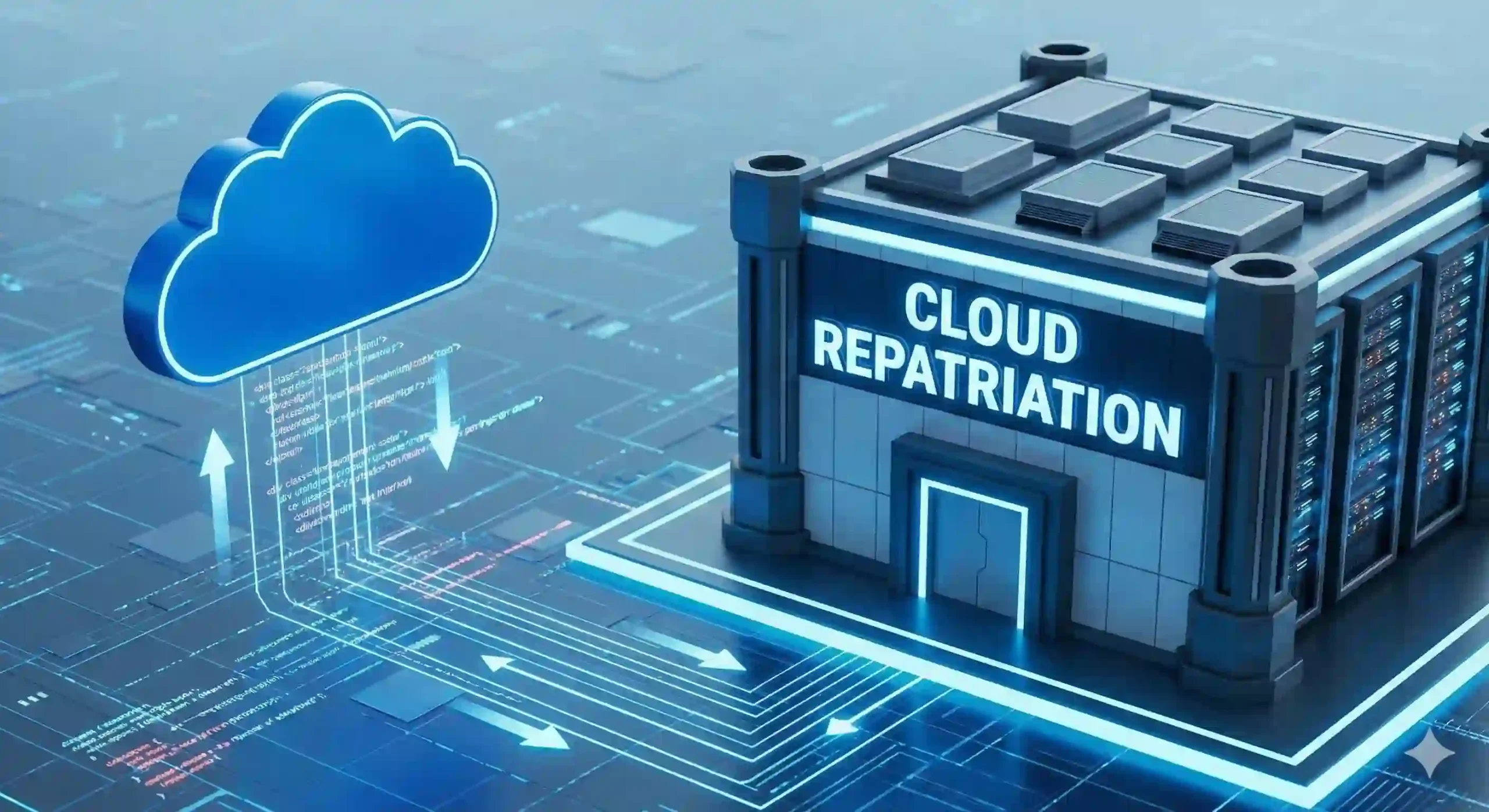
Cloud repatriation — moving workloads from public cloud back to private infrastructure — is no longer a contrarian take. It’s a calculated strategy that a growing number of enterprises are adopting as they mature past the “cloud-first everything” phase of the 2010s.
This article breaks down why organizations are bringing workloads home, which workloads make sense to move, and how to execute the transition without creating new problems. Whether you’re evaluating a full repatriation or a hybrid approach, the goal is the same: put each workload where it performs best and costs least.
What is Cloud Repatriation?
Cloud repatriation refers to the process of migrating workloads and data from public cloud environments back to private infrastructure or on-premises data centers. This decision often stems from organizations reassessing their cloud strategies to determine the benefits of in-house management of certain workloads. Unlike the initial rush to the cloud in the 2010s, where “cloud-first” was the mantra, repatriation represents a more mature, calculated approach to infrastructure management.
For example, a financial services firm may find that sensitive customer data is more secure and manageable when retained on private servers. This choice can lead to enhanced data governance and compliance, reducing the risks associated with third-party data handling. In essence, repatriation isn’t about abandoning the cloud entirely but about reclaiming control over critical assets. It’s a reversal of the “lift and shift” migrations that once dominated, now driven by a deeper understanding of operational realities.
With the acceleration of digital transformation, businesses frequently reevaluate their cloud strategies. Rather than simply reversing previous cloud adoptions, organizations view repatriation as a strategic adjustment tailored to their operational needs. This involves critically assessing which workloads are suited for public cloud versus private infrastructure.
Public Cloud vs. Private Cloud: A Paradigm Shift. Repatriation is not a step back, but a sign of business maturity. Companies are transitioning from chaotic resource consumption in public clouds to a hybrid model that balances flexibility with control. Public clouds like AWS and Azure remain ideal for elastic workloads—such as those experienced by startups, during seasonal sales spikes, or in R&D experiments where scalability is key. However, for many enterprises, the initial allure of “pay-as-you-go” has given way to the realization that not all workloads fit this model.
A hidden threat in public clouds is the accumulation of egress fees—charges for outgoing traffic—and vendor lock-in, which can turn the cloud into “financial shackles” at scale. These factors often surprise organizations as their data volumes grow, leading to bills that spiral out of control. In contrast, private cloud or bare-metal solutions are the choice for predictable and high-load systems, where capital expenditures (CapEx) on hardware can pay for themselves within 6–12 months compared to ongoing operational expenses (OpEx) in the cloud under constant load. This shift underscores a broader evolution: from cloud dependency to infrastructure sovereignty.
Why Are Organizations Choosing Repatriation?
Cost considerations are primary factors driving cloud repatriation. While public cloud services may initially appear cost-effective, organizations can encounter unforeseen expenses such as data egress fees and variable service charges. Many businesses find that maintaining specific workloads on private infrastructure results in lower overall costs in the long run.
For instance, a company with stable computing demands might find investing in dedicated hardware more economical than perpetuating ongoing cloud expenses. This “cloud tax”—often representing 50% or more in provider margins—can be eliminated through repatriation. Real-world examples abound: Dropbox famously repatriated its storage infrastructure in 2015, saving millions by building its own servers instead of relying on AWS. Similarly, 37signals (now Basecamp) pulled back from the cloud, citing massive savings from owning their file storage hardware. These cases highlight how repatriation can transform unpredictable OpEx into manageable CapEx, providing financial predictability.
Beyond direct savings, repatriation addresses the compounding costs of cloud sprawl. As teams provision resources independently, waste accumulates—unused instances, overprovisioned storage, and redundant services. By bringing workloads home, organizations can implement centralized governance, reducing this inefficiency. Industry surveys consistently show repatriation gaining momentum. Flexera’s 2024 State of the Cloud Report found that optimizing existing cloud spend remains the top initiative for 82% of enterprises — and for many, repatriation of stable workloads is part of that optimization.
Performance issues also motivate organizations to explore repatriation. Latency can significantly affect user experience, particularly for transaction-heavy applications. By relocating these workloads to private servers, companies gain greater control over network performance and processing speeds.
Consider a retail business that relies on real-time transaction processing. If public cloud latency affects customer satisfaction, repatriation may enhance performance significantly. For high-frequency trading (HFT) or real-time bidding systems in advertising, public cloud network latency is often unacceptable. Owning hardware allows full control over the network stack, from custom routing to optimized hardware configurations, potentially shaving milliseconds off response times—critical in industries where speed equals revenue.
Organizations that repatriate latency-sensitive workloads typically report measurable performance gains, primarily from eliminating shared-infrastructure variability and controlling the full network stack. The improvement varies by workload type, but for transaction-heavy systems, the difference between dedicated hardware and multi-tenant cloud instances is significant. This optimization extends to bandwidth management; in public clouds, bandwidth throttling during peak times can disrupt operations, whereas private setups offer dedicated pipes. As edge computing rises, repatriation aligns with placing compute closer to data sources, further boosting efficiency.
Compliance with data protection regulations is another major driver for cloud repatriation. Regulatory frameworks like GDPR and CCPA impose strict requirements on data management and location. Organizations might discover that housing sensitive data in-house reduces compliance risks. Retaining control over data environments can help meet regulatory obligations and protect customer privacy.
Data sovereignty—ensuring data resides in jurisdictions that align with legal requirements—is easier in a closed, private environment than through complex policy configurations in public clouds like AWS. Local data landing laws in regions like the EU or China mandate that certain data never leaves national borders, making public clouds risky. For industries like healthcare (HIPAA) or finance (PCI DSS), the audit trails and physical security of on-premises setups provide peace of mind.
Moreover, security breaches in public clouds—often due to misconfigurations—have eroded trust. Repatriation allows for bespoke security measures, such as air-gapped systems for ultra-sensitive data. Compliance is frequently cited as a primary or contributing factor in repatriation decisions, particularly in industries with strict data residency requirements.
Types of Workloads Suited for Repatriation
Transaction-intensive applications, such as payment processing systems, are ideal candidates for repatriation. These applications often require quick response times, leading to enhanced performance and reliability when managed internally rather than relying on public cloud infrastructure. In payment gateways, where every millisecond counts, the predictability of private hardware trumps the variability of cloud shared resources.
Data-intensive processes requiring extensive analytics frequently benefit from repatriation. For industries like healthcare and finance, meeting residency requirements for data storage is crucial for maintaining integrity and security. Data warehouses for analytics incur astronomical storage and egress costs in the cloud; repatriating them to owned storage arrays can slash expenses by 70%, as seen in enterprise migrations.
Workloads involving Artificial Intelligence (AI) and Machine Learning (ML) can be complex and resource-intensive. These specialized tasks may operate more efficiently within a hybrid cloud model, where organizations leverage on-premises resources for critical computations while utilizing public cloud services for less demanding tasks. Renting GPUs in the cloud 24/7 is economically unfeasible compared to purchasing your own H100 or B200 clusters. AI companies, in particular, are fleeing public clouds due to these costs; for instance, training large models like GPT variants can cost millions in cloud fees, but owned hardware amortizes over time.
Strategic Considerations for Cloud Repatriation
Before initiating repatriation, organizations should conduct a Total Cost of Ownership (TCO) analysis. This evaluation should encompass hardware investments, maintenance costs, and operational expenses associated with running a private cloud. Honest TCO is the key to the solution—often forgotten are costs like electricity, security, disk replacements, and the Ops team’s salary.
A thorough understanding of TCO enables stakeholders to compare expenses between cloud and on-premises solutions, ensuring financial implications are carefully assessed. Tools like AWS Cost Explorer or custom spreadsheets can model scenarios, revealing that for steady-state workloads, private infrastructure wins. Experts recommend factoring in a 3-5 year horizon, as initial CapEx dips below OpEx curves quickly.
Transitioning to private infrastructure necessitates skilled personnel. Organizations may face challenges in sourcing or training IT staff capable of managing on-premises servers, especially after predominantly relying on public cloud solutions. This skills gap can complicate the repatriation process and hinder operational efficiency.
Over the past 10 years, the industry has cultivated a generation of “Cloud Native” developers. Finding engineers who know how to work with real “hardware,” networking, and data center cooling is a huge problem. To bridge this, companies are investing in upskilling programs or partnering with managed service providers. The talent gap is a hidden risk often kept silent, but it’s critically important: without the right team, repatriation can lead to downtime and increased costs.
As the cloud computing landscape evolves, many organizations contemplate hybrid models that encompass both public and private infrastructures. This strategy optimizes workload placements based on performance, cost, and compliance needs. As firms evaluate repatriation, hybrid infrastructures could serve as an advantageous norm for maintaining flexibility and control.
Hybrid Cloud as the New Standard: Core Systems at Home, Burst Workloads in the Cloud. This approach keeps mission-critical, predictable workloads on-premises while bursting to the cloud for scalability. Emerging trends include multi-cloud hybrids to avoid vendor lock-in, with tools like Kubernetes enabling seamless orchestration.
Case Studies and Success Stories
Enterprises that have engaged in cloud repatriation often achieve significant cost savings. For instance, a prominent e-commerce platform chose to repatriate its data warehousing and analytics workloads, resulting in considerable annual savings. By managing these processes internally, they effectively reduced reliance on costly cloud services.
Dropbox migrated 90% of user data from AWS S3 to “Magic Pocket,” their custom storage system, between 2015 and 2016. According to their S-1 filing, the move saved $74.6 million in operating costs over two years — achieved through custom hardware, optimized replication (reducing disk usage by 25% for cold storage), and eliminating cloud provider margins.
37signals (Basecamp, HEY) completed their cloud exit from AWS in 2023, reducing annual cloud spending from $3.2 million to approximately $1.3 million. The initial hardware investment — around $600,000–$700,000 in Dell servers — was recouped within months. DHH (co-founder and CTO) projects $10 million+ in savings over five years. Their existing 10-person ops team handled the migration without additional hires.
Organizations that successfully navigated repatriation underscore the importance of a clear strategy and defined objectives. Identifying workloads that provide the most value when moved on-premises is critical for minimizing unwarranted costs and operational disruptions.
Why AI/ML Workloads Drive Repatriation: GPU-intensive AI training is among the most expensive cloud workloads. Renting NVIDIA H100 clusters 24/7 in the cloud can cost $2–$3 per GPU-hour, making large-scale training runs prohibitively expensive over time. Companies with predictable, sustained GPU demand — training pipelines that run continuously — increasingly find that purchasing hardware (despite the upfront CapEx) pays for itself within 12–18 months. This calculation has accelerated GPU repatriation across AI labs and enterprises building proprietary models.
Hidden Risks and Challenges
Underestimating migration complexity. Data transfer alone can take weeks to months for large datasets, and egress fees during migration can be substantial. A phased approach — starting with non-critical workloads — reduces risk but extends timelines.
Persistent vendor lock-in. Even after moving compute, applications built on proprietary cloud services (AWS Lambda, DynamoDB, Azure Cosmos DB) may require significant refactoring. API portability should be evaluated before any migration decision.
The talent gap. A decade of “cloud-native” development has produced engineers who’ve never managed physical hardware, networking, or data center operations. Without the right team, repatriation leads to downtime, misconfigurations, and costs that negate the savings.
Transition downtime. Moving production workloads requires robust failover plans. Organizations that attempt a “big bang” migration instead of a gradual cutover often face outages that damage customer trust.
Opportunity cost. Every engineering hour spent on infrastructure migration is an hour not spent on product development. The business case must account for this trade-off.
CTO Checklist: Are You Ready for Repatriation?
Spoiler: Do you have admins? Here’s a practical checklist for CTOs:
- Assess Workloads: Inventory all apps; classify by elasticity, sensitivity, and cost.
- Calculate TCO: Include all hidden costs (power, cooling, maintenance).
- Evaluate Talent: Audit team skills; plan for training hardware experts.
- Compliance Audit: Ensure repatriation aligns with regulations; map data flows.
- Hybrid Roadmap: Design for integration; test tools like VMware or OpenStack.
- Pilot Program: Start small—repatriate one workload to measure ROI.
- Vendor Negotiations: If partial, renegotiate contracts to minimize egress fees.
- Security Posture: Enhance on-premises defenses; consider zero-trust models.
- Scalability Plan: Prepare for growth; hybrid bursts prevent overprovisioning.
- Metrics Monitoring: Define KPIs like latency, cost savings, and uptime.
The Bottom Line
Cloud repatriation isn’t anti-cloud — it’s post-cloud-hype. The enterprises getting the best results aren’t choosing between cloud and on-prem. They’re choosing where each workload belongs based on cost, performance, compliance, and operational complexity.
The pattern is consistent: stable, predictable, data-heavy workloads cost less on owned infrastructure. Elastic, experimental, and bursty workloads belong in the cloud. The hybrid model isn’t a compromise — it’s the mature architecture that the “cloud-first everything” era was always going to evolve into.
The question isn’t whether to repatriate. It’s which workloads, when, and whether your team is ready to operate what you bring home.
Frequently Asked Questions
For stable, predictable workloads, cloud provider margins (“cloud tax”) can add 50–70% to the cost of equivalent on-premises infrastructure. By owning hardware, enterprises transform monthly OpEx into CapEx that typically pays for itself within 12–18 months. The math works best for workloads that run 24/7 at consistent load — databases, storage, training pipelines.
No. Most repatriation leads to a hybrid model: predictable core systems on-premises, elastic and experimental workloads in the cloud. The goal is optimization, not ideology. Even 37signals — the most vocal cloud exit advocate — still spends $1.3M/year on AWS for S3 storage.
Data sovereignty means your data is subject to the laws of the country where it’s stored. For industries governed by GDPR, HIPAA, or PCI DSS, controlling data location is critical. Public cloud providers offer region-specific data centers, but the policy configurations are complex. On-premises infrastructure gives you physical certainty about where data lives.
A generation of “cloud-native” engineers has limited experience with hardware provisioning, networking, and data center operations. Successful repatriation requires either hiring infrastructure specialists, investing in upskilling programs, or partnering with managed service providers. Without the right team, savings evaporate into downtime and misconfiguration.
Highly elastic workloads — startup MVPs, seasonal traffic spikes, R&D experiments, disaster recovery — belong in the cloud where pay-per-use pricing makes sense. If your usage is unpredictable or temporary, the cloud’s flexibility outweighs the cost premium.
Small-scale (one application, limited data): 2–4 months. Mid-scale (multiple workloads, moderate data): 6–12 months. Enterprise-scale (petabytes of data, complex dependencies): 12–24+ months. 37signals completed their cloud exit in approximately 6 months. Dropbox’s Magic Pocket migration took about 2.5 years at exabyte scale.
Yes, but the economics are different. A company spending $5,000–$10,000/month on cloud may not justify the overhead of running its own hardware. Colocation (renting rack space in a data center) can be a middle ground — you own the servers but outsource power, cooling, and physical security. The breakeven typically starts around $15,000–$20,000/month in cloud spend.
Include: server hardware (amortized over 3–5 years), networking equipment, colocation or data center costs (power, cooling, physical security), additional staff or training, migration engineering time (opportunity cost), and egress fees during migration. Compare this against your current cloud bill projected over the same 3–5 year period. Tools like AWS Cost Explorer can model current spend; the rest requires honest internal accounting.