Generative AI Development

We are a generative AI development company for products that have to run in production. We build AI agents, chatbots, retrieval over your documents, language-model features inside your product, and the pipelines that keep models trained and monitored. Four of the AI products we built are live, and a fifth reached a testable MVP. Each engagement starts with one use case and a set of tasks or conversations taken from your data. The result it has to reach, the pass bar, is agreed in advance. The pilot is planned at four to eight weeks.

Generative AI Development Services That Ship to Production

Our generative AI (GenAI) development services build the parts of an AI product that outlast the model. Those parts are retrieval over sources you have approved, an evaluation set that says whether the feature works on your data, and an approval step where an action has consequences. They also include a tracked cost per task and the pipeline that retrains and monitors the model. The prototypes brought to us usually have a model and a prompt. The rest is what we build first.

Environmental.AI drafts environmental assessment reports with the source shown for each generated statement. Preparation time dropped by up to 90%. Shift.AI, a voice companion for clinicians, was built with voice over retrieval-augmented generation (RAG). Revvel‘s AI review of medical records runs on OpenAI models and, per the client, delivers risk assessments up to 10x faster than traditional review. Hello, We Hire verifies candidate claims with RAG and pre-screens 1,000 candidates per hour. InnerPeak.AI gives students and teachers an in-app AI coach.

We offer eight services, six with their own page, each stating its scope and its pilot terms. AI agent development covers software that acts inside your systems. AI chatbot development covers assistants that answer. RAG development is the retrieval layer, AI integration connects models to the product you already run, and MLOps consulting builds the pipelines around the models. Machine learning development builds predictive models. LLM development and AI product development are scoped inside those pages. For clinical AI, see healthcare AI consulting. The retrieval layer in code is the community edition of our open-source RAG platform, and the training step is our open-source AML training pipeline.

Send us the use case to start scoping.

What a Production AI System Needs
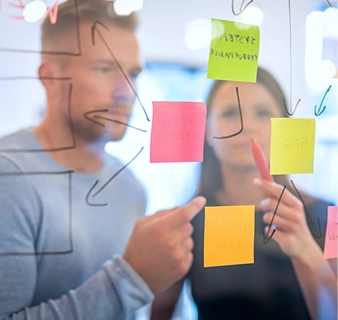
A model and a prompt make a demo. Six things make a system people rely on, and each engagement builds them in this order.
01
Retrieval and Data Foundation
Approved sources, document pipelines, vector search (which matches by meaning), and the retrieval log behind each answer, scoped to each user's permissions. The retrieval layer is built before the feature, because it is what the model answers from.
01
Approved sources, document pipelines, vector search (which matches by meaning), and the retrieval log behind each answer, scoped to each user's permissions. The retrieval layer is built before the feature, because it is what the model answers from.
02
Evaluation and Testing
An evaluation set from your own conversations, tasks, or records, with a pass bar agreed before the build. For a chatbot it covers answers and unsupported statements; for an agent, tasks completed and blocked actions. It is re-run on each change.
02
An evaluation set from your own conversations, tasks, or records, with a pass bar agreed before the build. For a chatbot it covers answers and unsupported statements; for an agent, tasks completed and blocked actions. It is re-run on each change.
Challenges 1 image
03
Task Boundary and Approval
Where an AI feature can change something, the boundary is written in three tiers: actions it takes alone, proposes, or never takes, enforced in the code that runs them. Consequential actions wait for a named approver, and an unanswered request expires.
03
Where an AI feature can change something, the boundary is written in three tiers: actions it takes alone, proposes, or never takes, enforced in the code that runs them. Consequential actions wait for a named approver, and an unanswered request expires.
04
Multi-Model Routing and Cost
Routing is designed to send 60 to 80% of traffic to cheaper models and reserve the larger one for the requests that need it. Caching and batching cover the rest. Savings of 30 to 70% are the range we plan against, and the pilot measures the cost per task.
04
Routing is designed to send 60 to 80% of traffic to cheaper models and reserve the larger one for the requests that need it. Caching and batching cover the rest. Savings of 30 to 70% are the range we plan against, and the pilot measures the cost per task.
05
Security and Privacy
Tool results and retrieved documents are handled as untrusted data, and the tiers decide which actions may follow them. Identifiers are masked where possible, and hosted models run under terms that exclude training on your inputs. Audit records come from the logs.
05
Tool results and retrieved documents are handled as untrusted data, and the tiers decide which actions may follow them. Identifiers are masked where possible, and hosted models run under terms that exclude training on your inputs. Audit records come from the logs.
Challenges 2 image
06
Deployment, Operations, and Observability
Containers in your cloud account or ours, releases to a slice of traffic, rollback to the previous version in the registry, and dashboards with model metrics next to business metrics. Drift monitoring, a logged trace per request, and retraining approved by a person.
06
Containers in your cloud account or ours, releases to a slice of traffic, rollback to the previous version in the registry, and dashboards with model metrics next to business metrics. Drift monitoring, a logged trace per request, and retraining approved by a person.

Services

RAG Development
The retrieval layer behind chatbots, agents, and drafting features: an approved source set, the sources attached to each answer, and a retrieval log that shows what the model saw. Sources are re-indexed when you publish a change or on a schedule you set, and the log records which version answered. Environmental.AI drafts its environmental assessment reports this way, with the source shown for each statement. The community edition of our RAG platform (Apache 2.0) is the starting point when you want to own the layer.


AI Chatbot Development
Chatbots for support, sales, in-app help, and staff questions that answer from your approved sources, show the source, and hand off to a person with the transcript and a summary. The pass bar covers questions answered correctly, handoffs made when due, unsupported statements (hallucinations) with zero as the target, and cost per conversation. Voice and text run on one retrieval core; Shift.AI's voice companion for clinicians was built on it. The bot says it is an AI at the start of the conversation.


AI Agent Development
Agents that take a goal, call the tools your team uses, and hand consequential actions to a person. Each is built with a written task boundary in three tiers, enforced in the tool layer with separate credentials per tier. The model cannot promote an action from one tier to another. The pilot is one task and reports tasks completed, disallowed actions attempted and blocked, cost per task, and time per task. It ends with a decision to continue or stop.


Generative AI Integration
Language-model features go into the product you already run, behind your existing API. They are switched on per customer with a feature flag (a per-account on/off setting), so the feature does not have to enter your release cycle. Use cases include CRM and helpdesk intelligence, document workflows, and internal copilots for support and sales. The first feature is usually one your team does by hand today, and later features reuse the same retrieval layer, evaluation pipeline, and approval step.


MLOps Consulting
Training pipelines that rerun from a commit, a registry that says which version is live, and deployment that can roll back. Monitoring flags drift in live inputs against thresholds you agreed. A two-to-three-week assessment maps each model's lifecycle (data, training code, deployment path, owner, what happens on drift) and orders the gaps by risk. The first pipeline follows in four to eight weeks. Retraining is triggered by a signal and approved by a person.


Machine Learning Development
Predictive models on your operational, clinical, or transaction data: scoring, classification, forecasting, and anomaly detection, with an evaluation set held back from training and agreed before the build. Models ship through the same registry, deployment, and monitoring as the generative features, so a product that needs both runs them on one operations layer. The training step is public in our open-source AML pipeline.


LLM Development
Prompt and model versioning, outputs in a fixed schema, and an evaluation set re-run on each change. The model sits behind an interface so it can be swapped when the market changes. We build on OpenAI, Anthropic, and Google models and on open-weight models such as Llama (ones you host yourself), and route between them by task. Open-weight models can be fine-tuned when prompting is not enough, and they run in your cloud when the data cannot leave.
AI Product Development
The product around the model: chat and copilot interfaces, AI dashboards, admin panels with transcript search and analytics, and the SaaS platform customers pay for. Our engineers work in your repository and your build pipeline with a weekly demo, and the code, prompts, evaluation set, and runbook written for you are yours from day one. Revvel, InnerPeak.AI, and Hello, We Hire are products we built the AI features for.
The retrieval layer behind chatbots, agents, and drafting features: an approved source set, the sources attached to each answer, and a retrieval log that shows what the model saw. Sources are re-indexed when you publish a change or on a schedule you set, and the log records which version answered. Environmental.AI drafts its environmental assessment reports this way, with the source shown for each statement. The community edition of our RAG platform (Apache 2.0) is the starting point when you want to own the layer.


girl sitting near the laptop

Our Case Studies

Hola Salud
HolaSalud Logo
Hola Salud

Digital healthcare platform for Mexico.

We built a complete healthcare ecosystem, including a patient app, a doctor’s portal, and an admin backend, with self-registration, appointment booking, medical records, and integrated Stripe and Oxxo payments.

Read the entire case
Environmental AI
Environmental AI Logo Black
Environmental AI

Environmental compliance automation.

We built a RAG-based system that automates environmental assessment documents and regulatory templates, cutting preparation time by up to 90%.
Read the entire case
Revvel
Revvel logo
Revvel

AI-powered women’s health platform.

We developed an AI platform that turns elite health experts into digital twins and reviews years of patient data in under 60 seconds, delivering risk assessments up to 10x faster and cutting time-to-care from days to minutes.
Read the entire case
InnerPeak.AI
InnerPeakAI logo
InnerPeak.AI

Student mental wellness platform.

We developed a comprehensive web and mobile application that provides students and teachers with 24/7 personalized support and engaging resilience training to build essential life skills.
Read the entire case
Hello, We Hire
HelloWeHire logo
Hello, We Hire

AI-driven recruitment automation platform.

We built an AI-powered recruitment system with automated pre-screening, real-time skills evaluation, and multi-stage verification that speeds up hiring by 94%.

Read the entire case
Hola Salud
HolaSalud Logo
Hola Salud

Digital healthcare platform for Mexico.

We built a complete healthcare ecosystem, including a patient app, a doctor’s portal, and an admin backend, with self-registration, appointment booking, medical records, and integrated Stripe and Oxxo payments.

Read the entire case
Environmental AI
Environmental AI Logo Black
Environmental AI

Environmental compliance automation.

We built a RAG-based system that automates environmental assessment documents and regulatory templates, cutting preparation time by up to 90%.

Read the entire case
Revvel
Revvel logo
Revvel

AI-powered women’s health platform.

We developed an AI platform that turns elite health experts into digital twins and reviews years of patient data in under 60 seconds, delivering risk assessments up to 10x faster and cutting time-to-care from days to minutes.

Read the entire case
InnerPeak.AI
InnerPeakAI logo
InnerPeak.AI

Student mental wellness platform.

We developed a comprehensive web and mobile application that provides students and teachers with 24/7 personalized support and engaging resilience training to build essential life skills.

Read the entire case
Hello, We Hire
HelloWeHire logo
Hello, We Hire

AI-driven recruitment automation platform.

We built an AI-powered recruitment system with automated pre-screening, real-time skills evaluation, and multi-stage verification that speeds up hiring by 94%.

Read the entire case

Why Plus8Soft?

01
Experience
Multiplied by AI
We blend deep engineering expertise with cutting-edge AI acceleration. By integrating intelligent tools into our workflow, we don't just write code—we engineer solutions faster and with higher precision.
02
Business-First
Transparency
We look beyond the ticket. Our team operates with hyper-transparency, treating your budget and goals as our own. We align technical decisions with your business strategy to create real, measurable value.
03
Committed to
Overdelivery
Meeting requirements is our baseline; exceeding them is our culture. Whether it's optimizing performance, refining UX, or anticipating future scalability, we consistently go the extra mile.

Frequently Asked Questions

What types of companies do you work with on generative AI?
AI startups building their first production system, SaaS companies adding AI to an existing product, and enterprises putting AI into operations. The five products above cover health, environmental compliance, recruitment, and education, and the generative AI solutions in them run on the same retrieval, evaluation, and approval layers.
We have a working AI prototype. Can you take it to production?
Yes, and this is the most common starting point. A prototype taken to production usually keeps its model, and the work is everything around it. That means the retrieval, evaluation, approval, and deployment layers, plus the API layer, error handling, and the product experience. The first step is an evaluation set from your own data, which gives the pilot its pass bar before anything is rebuilt.
How long does generative AI development take with Plus8Soft?
Scoping takes two to three weeks, and a pilot on one use case follows at four to eight weeks. The figures are planning estimates, confirmed in the scope. From the start of scoping, a focused AI feature, such as a copilot, document processing, or search, takes two to four months. A full platform with training pipelines, inference, monitoring, and product UI takes six to twelve months in phases. Once the pilot is approved for production, a production increment ships each two to four weeks.
How much does generative AI development cost?
Scoping is quoted as a fixed fee before it starts, and the pilot is priced from the scope. Production phases are priced per increment. Integrated platforms with AI features, the six-to-twelve-month engagement, start at $250,000. Model usage fees are paid to the provider and scale with volume. The pilot reports cost per task as one of its numbers.
Do you work with specific LLM providers, or are you model-agnostic?
Model-agnostic. We build on OpenAI, Anthropic, and Google models and on open-weight models such as Llama. The model sits behind an interface. When the market changes, the model is swapped and the rest of the system stays. If your security team has already approved a provider, we build on it.
How is generative AI development different from traditional machine learning, and which do we need?
A traditional model predicts a number or a class from your data, such as a risk score or a fraud flag, and is trained on your records. A generative model produces text, speech, or actions from a prompt and the sources it is given. It is adapted with retrieval, prompts, and an evaluation set, with training on your data as the last resort. If the question is "what will happen" or "which category", you need machine learning development. If the question is "answer, draft, or act", you need one of the generative services above. Many products need both, and they share the evaluation and deployment layers.
How do you handle AI security and prevent prompt injection?
The tool layer decides which actions may follow an instruction found in a document or a tool result, so an injected instruction can trigger only the actions its tier allows. Injection attempts are part of the evaluation set. Around that we add input validation, output filtering, role-based access, masking of personal identifiers (PII), rate limiting, and monitoring for adversarial patterns. For regulated environments we add audit logging, data residency controls, and the model records your compliance function asks for, including the decision log.
How do you work with our engineers, and who owns the code?
Our engineers work in your repository and your build pipeline, with a weekly demo. The feature ships behind your existing API, so it does not have to enter your release cycle. The code, prompts, evaluation set, and runbook written for you are yours from day one. For an agent, chatbot, or clinical feature, a pilot team is an ML engineer, a backend engineer, and a project manager. An MLOps assessment is an ML engineer and a DevOps engineer. After the pilot, the team continues under one of the engagement models above.

Turn AI Into a Product, Not a Project

Send us the use case, the data it would draw on, and who would review the output. On the call, we say which of the eight services it belongs to and what the pilot has to prove. The pass bar is agreed before the build, the pilot ends in a decision you can take, and the code, prompts, and evaluation set are yours.
Discuss Your Project
Back to top