
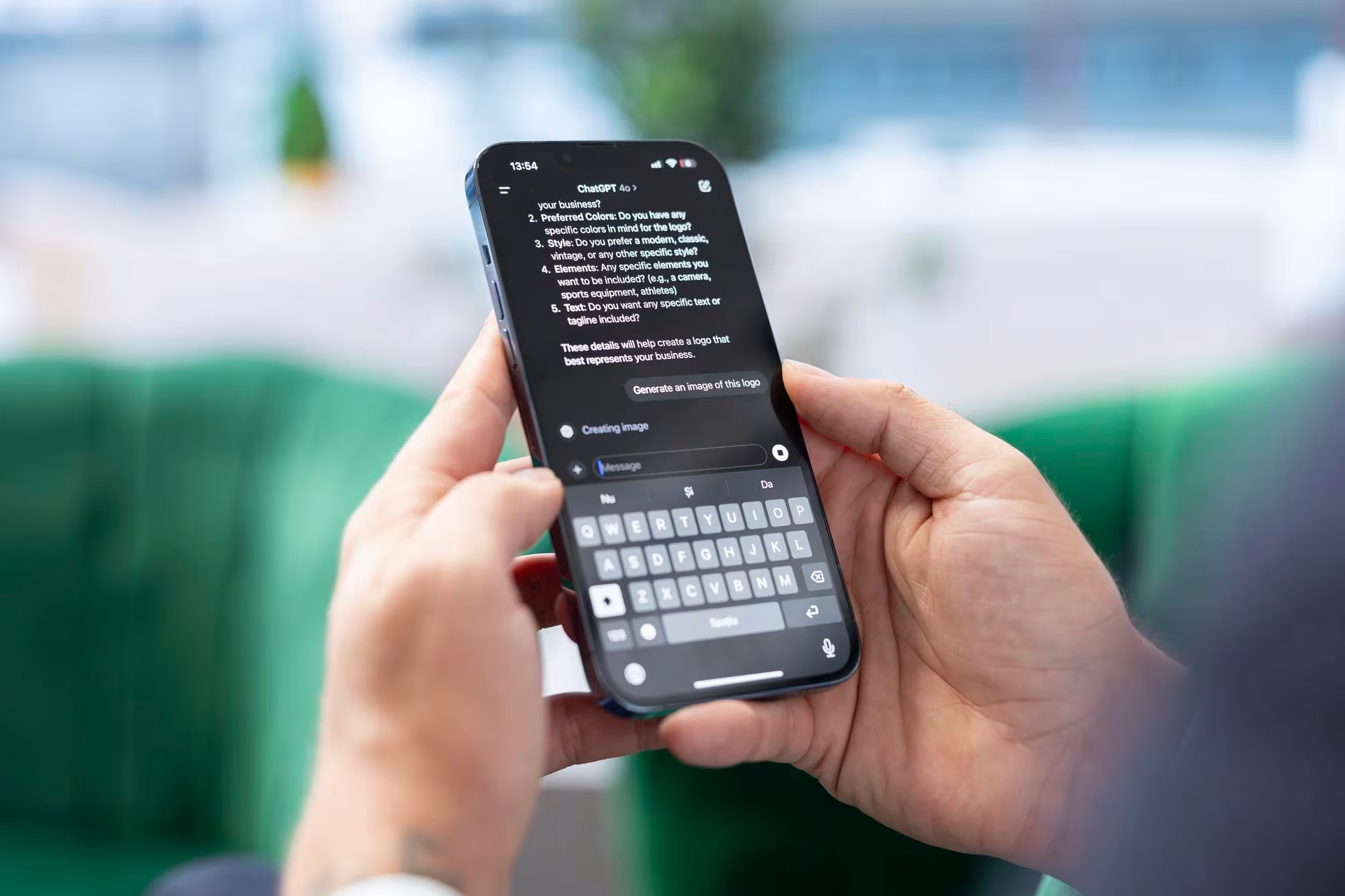
AI Chatbot Development Services
We build AI chatbots for support, sales, in-app help, and staff questions that answer from your approved sources and show where each answer came from. When a question falls outside those sources, the bot says so and hands the conversation to a person. Voice and text share one retrieval core. Our AI chatbot development services cover the scoping, the bot, its handoff rules, and the evaluation that shows how it performs on your own conversations.
AI Chatbot Development Services Built on Your Own Sources
A chatbot answers; an agent acts. Our AI chatbot development services start from the questions your team answers by hand today. Scoping settles which documents, tickets, and product data the bot may draw on and when it hands off to a person. There is no budget for a second attempt. In Gartner’s survey of 199 service and support leaders (April to May 2026, published August 2026), AI spending rose 38% while overall budgets rose 2%.
As an AI chatbot development company, we build the retrieval layer first. For Shift.AI, a voice companion for clinicians, the assistant works by voice over RAG with conversation memory across sessions. For InnerPeak.AI, a mental health platform for students and teachers, we built the mood tracker and the in-app AI coach that gives personalized recommendations from the chat. The same retrieval pattern runs Environmental.AI‘s report drafting.
The MVP is a working chatbot on one channel over your sources, planned at four to eight weeks. Scoping takes two to three weeks before that and produces:
- The question set the bot will cover, taken from your conversations, and the questions it will hand off.
- The approved source list, the access each source needs, and who writes the answers the sources do not cover.
- An evaluation set of real conversations and the pass bar (the four numbers the MVP must hit) agreed with your support or sales lead.
- A build estimate for the MVP.
Send us a sample of your conversations to start scoping.
Chatbots that need to change something in a system, such as closing a ticket or issuing a refund, are agents, and we build those under our AI agent development services. For the retrieval layer on its own, see RAG development services, and for connecting a chatbot to your helpdesk, CRM, and product API, see AI integration services. For clinical voice and patient-facing assistants, see healthcare AI consulting. This page sits under our generative AI development hub.
Custom AI Chatbots We Build
Six kinds of chatbots cover most of the requests we scope. The support handoff pattern is scoped and evaluated with you on your own conversations.
01
Voice Assistants and Voicebots
Conversational AI chatbot development for assistants that listen and speak: speech-to-text in front, the retrieval core, text-to-speech behind, memory across sessions. Shift.AI was built this way.
01
Conversational AI chatbot development for assistants that listen and speak: speech-to-text in front, the retrieval core, text-to-speech behind, memory across sessions. Shift.AI was built this way.

02
In-App Assistants
We do AI chatbot app development inside your web or mobile product. The assistant knows the user's screen and account data and answers from your product docs. For InnerPeak.AI, the in-app AI coach gives personalized recommendations from the chat.
02
We do AI chatbot app development inside your web or mobile product. The assistant knows the user's screen and account data and answers from your product docs. For InnerPeak.AI, the in-app AI coach gives personalized recommendations from the chat.
03
Enterprise Knowledge Chatbots in Slack and Teams
Enterprise AI chatbots that answer staff questions from Confluence, Google Docs, PDFs, and tickets, with the source on each answer. Archie, our hackathon Slack bot, was tested on 600 client documents. In a client build, each user sees only what their access allows.
03
Enterprise AI chatbots that answer staff questions from Confluence, Google Docs, PDFs, and tickets, with the source on each answer. Archie, our hackathon Slack bot, was tested on 600 client documents. In a client build, each user sees only what their access allows.
04
Customer Support Chatbots
The bot answers from your help center, policies, and ticket history, confirms the customer's context from your CRM, and hands off to your support team with the transcript. Containment, the share of conversations closed without a person, is measured on your own tickets.
04
The bot answers from your help center, policies, and ticket history, confirms the customer's context from your CRM, and hands off to your support team with the transcript. Containment, the share of conversations closed without a person, is measured on your own tickets.
05
Lead Capture and Sales Chatbots
The bot qualifies a visitor against your criteria and answers product and pricing questions from approved pages. It offers your booking link and sends the lead summary to your CRM as part of the handoff. Sales reads one note with the visitor's questions.
05
The bot qualifies a visitor against your criteria and answers product and pricing questions from approved pages. It offers your booking link and sends the lead summary to your CRM as part of the handoff. Sales reads one note with the visitor's questions.

06
Chatbots for Regulated Industries
We build these for healthcare, education, and fintech. Your compliance or clinical lead reviews the answer set, identifiers are masked where the use case allows, and transcripts are kept under your policy. The bot declines what it is not approved to answer.
06
We build these for healthcare, education, and fintech. Your compliance or clinical lead reviews the answer set, identifiers are masked where the use case allows, and transcripts are kept under your policy. The bot declines what it is not approved to answer.
What Our Enterprise AI Chatbot Development Includes
Scoping on Real Conversations
Scoping starts from a sample of your conversations: tickets, chat logs, call transcripts, or sales emails. We cluster them into the questions the bot will cover and the ones it will hand off. Each group gets an answer policy: answer from sources, ask a clarifying question, or hand off. Where the sources do not cover a question, your team writes the answer or the bot hands it off. Scoping lists which questions get each treatment and how many hours of your lead's time the review takes. The evaluation set and the pass bar are agreed before the build starts. The MVP team is an ML engineer, a backend engineer, and a project manager, with your lead reviewing the bot's answers.
Retrieval on Approved Sources
The bot answers through RAG over documents your team has approved: help center, policies, product data, ticket resolutions. The retrieved sources are attached to each answer, and a retrieval log shows what the model saw and which version of a source answered. An answer flagged in review can then be traced to the passage or the gap behind it. When no source matches the question closely enough (the cutoff is set at scoping), the bot hands off. The bot picks up changes to a source when you publish them or on a schedule you set. The community edition of our RAG platform, open source under Apache 2.0, is the starting point when you want to own the retrieval layer.
Handoff and Guardrails
Handoff rules are written at scoping: a question outside the sources, a customer who asks for a person, a topic you define, or a source match below your cutoff. The handoff carries the transcript, the sources the bot used, and a summary, so the person does not start over. The bot says it is an AI at the start of the conversation and is built not to claim to be a person, with that check in the evaluation set. Topic filters keep the bot inside its scope, and the evaluation set includes adversarial prompts: off-topic requests and instructions to ignore its rules. When your lead flags an answer, the passage is corrected or removed from the sources and the question joins the evaluation set. Your lead can disable a topic from the admin panel while the fix is made.
Channels and Integrations
One core, several channels: a web widget, in-app chat, WhatsApp and SMS under the providers' messaging rules, Slack and Teams, email, and voice through speech-to-text and text-to-speech vendors. The core connects to your helpdesk and CRM for context and handoff, and to your product API for account data. Adding a channel is a small piece of connecting code on the same core, so a second channel starts from the first one's sources, rules, and evaluation set. Each language gets its own evaluation subset and speech vendor check, and scoping lists the languages covered.
Evaluation and Monitoring
The evaluation set is built from real conversations with known good answers. The pass bar covers four numbers: questions answered correctly, handoffs made when they should be, unsupported statements (the target is zero), and cost per conversation. The set is re-run on any change of model, prompt, or sources. For support bots, containment is reported next to them. Your lead gets an admin panel with transcript search, the four numbers over time, the questions the sources did not cover, and a switch to disable a topic. Any transcript can be flagged from it. Drift monitoring, which checks that live questions still resemble the evaluation set, flags the topics the sources no longer cover.
Model Choice, Hosting, and Data
The model is swappable: we can change which model answers without rebuilding the bot. We deploy in your cloud account or ours, with open-weight models (ones you host yourself, such as Llama) when the data cannot leave. Transcripts are stored under your retention policy. The bot code, prompts, source connectors, and evaluation set written for you are yours, and our open-source components stay under their Apache 2.0 license.
Scoping starts from a sample of your conversations: tickets, chat logs, call transcripts, or sales emails. We cluster them into the questions the bot will cover and the ones it will hand off. Each group gets an answer policy: answer from sources, ask a clarifying question, or hand off. Where the sources do not cover a question, your team writes the answer or the bot hands it off. Scoping lists which questions get each treatment and how many hours of your lead's time the review takes. The evaluation set and the pass bar are agreed before the build starts. The MVP team is an ML engineer, a backend engineer, and a project manager, with your lead reviewing the bot's answers.

Case Studies
InnerPeak.AI
InnerPeak.AI
Student mental wellness platform.
We developed a comprehensive web and mobile application that provides students and teachers with 24/7 personalized support and engaging resilience training to build essential life skills.
Environmental.AI

Environmental.AI
Environmental compliance automation.
We built a RAG-based system that automates environmental assessment documents and regulatory templates, cutting preparation time by up to 90%.
FitEcho

FitEcho
A voice-input app for personal trainers, where workouts are logged by voice command at 90% accuracy.
We developed the app that generates exercises and shows progress analytics. Workout creation went from an hour to five minutes.
Shift.AI

Shift.AI
AI support tool for clinicians, built for Inclusive Health.
We built a mobile app that gives clinicians brief, trauma-informed AI support in real time, with bidirectional voice chat, guided meditation and grounding flows, and conversation memory across sessions. The MVP was delivered in 3 weeks.
Flexible Developer Hiring Model
Your priorities define the way we work together — from how much control you want to the level of flexibility your project demands.
Team Augmentation
Quickly scale your workforce with skilled developers who integrate seamlessly into your in-house team, filling talent gaps and boosting productivity.
Read more
Dedicated Development Team
A whole, cross-functional team working exclusively on your project, providing end-to-end development, management, and long-term support.
Read more
Software Development Outsourcing
Delegate your entire project to our specialists and focus on business growth, while we handle development, delivery, and quality.
Read more
Why Plus8Soft?
01
Experience
Multiplied by AI
Multiplied by AI
We blend deep engineering expertise with cutting-edge AI acceleration. By integrating intelligent tools into our workflow, we don't just write code—we engineer solutions faster and with higher precision.
02
Business-First
Transparency
Transparency
We look beyond the ticket. Our team operates with hyper-transparency, treating your budget and goals as our own. We align technical decisions with your business strategy to create real, measurable value.
03
Committed to
Overdelivery
Overdelivery
Meeting requirements is our baseline; exceeding them is our culture. Whether it's optimizing performance, refining UX, or anticipating future scalability, we consistently go the extra mile.
AI Chatbot Development FAQ
What is the difference between an AI chatbot and an AI agent, and which one do we need?
A chatbot takes a message and returns an answer. An agent takes a goal, works out the steps, calls tools and systems to carry them out, and runs the checks defined for the task. If the work ends when the user has the answer (support, FAQ, lead capture), you need a chatbot. If the work ends when something has changed in a system (a ticket closed or a claim routed for payment), you need an agent, and we build those separately. The design question is then which of those changes a person must approve.
How long does it take to build an AI chatbot with Plus8Soft?
Scoping takes two to three weeks. The MVP, with the handoff in place, is planned at four to eight weeks after that, and further channels take days to weeks each. The figures are our planning estimates and are confirmed in the scope.
How much does custom AI chatbot development cost?
Scoping is quoted as a fixed fee before it starts. The MVP is priced from the scope, and each further channel or source is estimated on its own. The cost follows the number of sources and integrations more than the model. Model and speech vendor fees are paid to those providers and scale with conversation volume. The cost per conversation is one of the four numbers the MVP reports.
How do you stop the chatbot from making things up?
We limit what it can draw on and measure what it says. The bot answers from sources your team approved, attaches the retrieved sources to each answer, and says when the answer is not there. Unsupported statements, answers without support in the sources, are one of the four numbers in the evaluation set, with a target of zero. After launch, your lead reviews a weekly sample of transcripts.
Do you build rule-based or LLM-based chatbots, and on which platforms?
Both, by the question set. A scripted flow is enough when the bot asks a few fixed questions and routes the answer. We build on language models when the questions vary and the answers live in your documents. The models are APIs from OpenAI, Anthropic, and Google and open-weight models such as Llama, with LangChain, LlamaIndex, or Haystack when the task needs a framework and plain code otherwise. If you already run a chatbot platform, we connect to it as a channel, and if your security team has approved a model or speech vendor, we build on it.
Can the chatbot run in our cloud without customer data leaving it?
Yes. The bot, the retrieval layer, and the transcripts deploy in your cloud account, and an open-weight model hosted there keeps the data inside it. When a hosted model is the better choice, text goes only to endpoints whose enterprise terms exclude training on your inputs. Zero-retention endpoints (the provider keeps no copy of the text) are used where the provider offers them for that model and feature. Identifiers are masked first where the use case allows.
How do you measure whether the chatbot works?
We measure it against the evaluation set described under Evaluation and Monitoring, agreed with your support or sales lead before the build. The run reports the four numbers and is repeated after any change. After launch, the admin panel shows the same numbers over time and the questions the sources did not cover, so your lead sees what to add next.
Can you add a chatbot to a website or product we already have?
Yes. The web widget and the in-app assistant connect to your existing API, and the sources are the help center and product docs you already maintain. The first version usually covers the questions your team answers most often by hand, with the handoff placed where that person picks up today.
When would you tell us to use an off-the-shelf support bot instead of a custom build?
On the first call or in scoping, when your questions live in one helpdesk whose built-in bot already covers them, we say so. We build custom when the answers come from several systems, when the bot has to run in your cloud, or when you need voice and text on one core. The evaluation set and the handoff rules are then yours to change. What a custom build adds over a GPT builder is the evaluation set on your transcripts, the retrieval log, and access scoping per source.
Can the same chatbot work by voice?
Yes. Voice is a channel on the same core, with speech-to-text and text-to-speech wrapped around the same retrieval and rules. Shift.AI, the voice companion for clinicians, works by voice over the same retrieval core. For a new voice bot, the evaluation set gets a spoken subset, because questions sound different from how they are typed. We choose speech vendors with your data terms in mind. For FitEcho, a trainer app with voice input and no chatbot, voice commands log workouts at 90% accuracy.
Does the chatbot work in more than one language?
Yes, where the sources and the evaluation set cover it. Each language gets its own evaluation subset and, for voice, its own speech vendor check, and scoping lists the languages covered. Answers come from sources in that language or from translated sources your team has approved.
Who maintains the chatbot after launch?
Your team or ours. We can run the bot in production, with source updates, evaluation re-runs, and model updates, or hand it to your team with the admin panel and the evaluation pipeline. The bot code, prompts, source connectors, and evaluation set written for you are yours in both cases.