Telemedicine Software Development: What Goes Into the Build


What You're Actually Building
Telemedicine software development means building a connected system, not a single app: a patient-facing app, a provider portal, an admin backend, and the integrations that tie them to scheduling, payments, and existing medical records. A focused MVP typically runs 3 to 6 months; a full multi-portal platform with EHR integration runs longer.
Demand normalized after the pandemic peak rather than collapsing. 71.4% of physicians were in practices using telehealth in 2024, according to the American Medical Association’s Physician Practice Benchmark Survey, up from 25.1% in 2018 and down from the 79.0% peak in 2020. The CDC’s National Center for Health Statistics found the same pattern among office-based physicians: 80.0% used telemedicine in 2024, against 86.5% in 2021. Usage settled below its peak and stayed there. This guide covers what actually goes into the build, what HIPAA requires in practice, and where AI genuinely fits in 2026.
Telemedicine vs Telehealth: The Distinction That Actually Matters
Telemedicine refers specifically to clinical services delivered remotely: video consultations, remote diagnosis, prescription management. Telehealth is the broader umbrella, covering telemedicine plus non-clinical services like patient education, administrative scheduling, and provider training.
The distinction matters for scoping. A pure telemedicine build centers on the consultation itself: video, scheduling, clinical documentation. A telehealth platform often adds patient portals, e-learning, and administrative tooling around that clinical core. Most real projects, including the case studies below, end up somewhere in between.
What's Actually Inside a Telemedicine Platform
Self-serve registration, doctor selection, appointment booking, and secure payment. For a Mexico-based virtual care platform we built for Hola Salud, this meant supporting both Stripe and Oxxo, since cash-voucher payment is widely used there.
A single dashboard replacing scattered tools: patient list, schedule, and the consultation itself, so the doctor’s time goes to care instead of switching between systems.
Approving providers, managing documents, and adjusting pricing or specialties without needing an engineer for routine changes.
Prescriptions and records need to move between systems automatically. On the Hola Salud platform, a prescription lands in the patient’s app the moment a doctor issues it, tied directly into pharmacy fulfillment.
How the Pieces Actually Connect
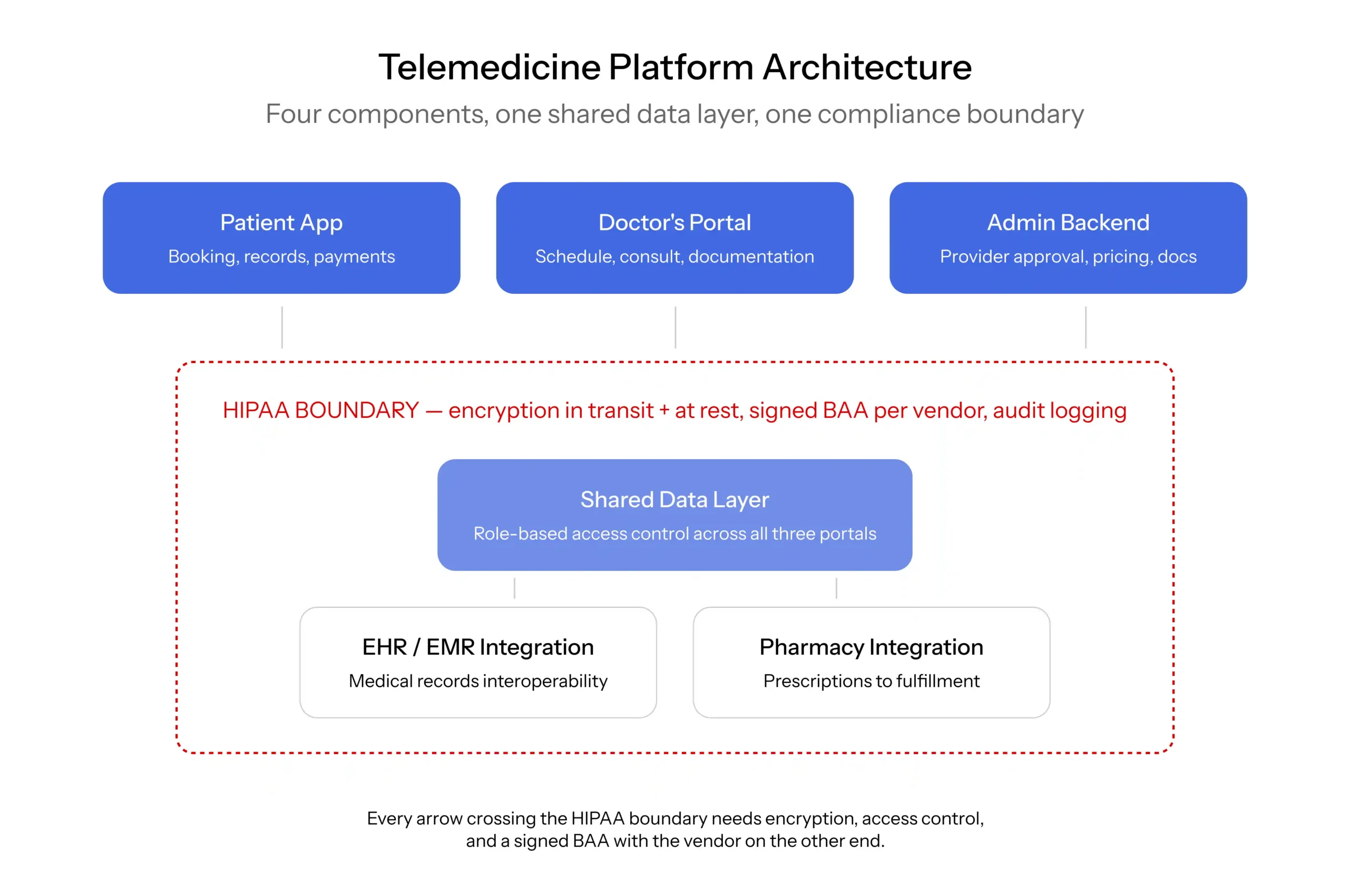
Three portals, one shared data layer, and a compliance boundary that wraps everything crossing it. This is the shape nearly every real telemedicine build takes, regardless of which pieces get built custom versus white-label.
What an Early-Stage Healthcare Platform Actually Needs
Custom vs White-Label vs Hybrid Telemedicine Platforms
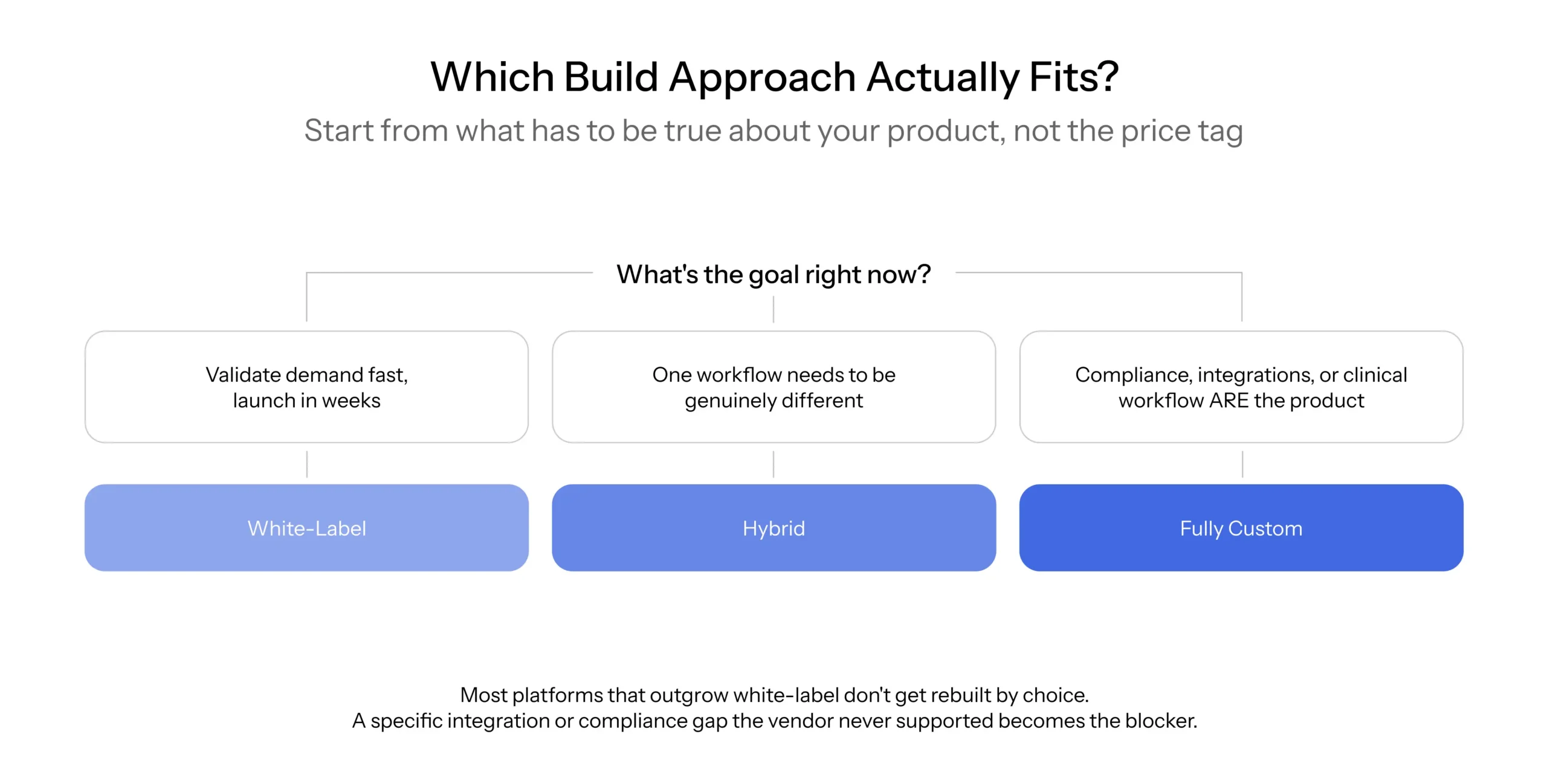
White-label platforms get you live faster. They also cap how far you can go once you need something the vendor didn’t build for.
Most platforms that outgrow a white-label start don’t get rebuilt by choice. They get rebuilt because a specific integration or compliance requirement the vendor never supported becomes a blocker.
HIPAA: What's Actually Required Right Now
A lot of 2026 content treats the proposed HIPAA Security Rule update as if it’s already law. It isn’t. HHS published the update as a Notice of Proposed Rulemaking in December 2024, and as of mid-2026 it remains proposed, with OMB now targeting final action for July 2027. Building against requirements that aren’t in effect yet, while missing what already is, is a common and avoidable mistake.
What’s actually enforceable today, per HHS OCR’s current telehealth guidance, is the existing Security Rule applied to virtual care: encryption of PHI in transit and at rest, access controls, audit logging, and a signed Business Associate Agreement (BAA) with every vendor whose technology touches patient data, including the video, chat, and hosting infrastructure. Penalties under the current rule are tiered by culpability. Following the inflation adjustment effective January 28, 2026, the statutory maximum is $2,190,294 per identical provision per calendar year, but OCR’s standing 2019 enforcement-discretion notice caps three of the four tiers far lower, at roughly $36,505, $146,053, and $365,052. Only the top tier, willful neglect left uncorrected, is exposed to the full amount.
In practice, this means BAAs signed before integrating any third-party service, encryption in transit and at rest as a default rather than an afterthought, audit trails on every record access, and role-based access control between what a patient, a doctor, and an admin can each see. Our healthcare development practice builds this into the architecture from the first sprint, not as a pre-launch audit.
Where AI Genuinely Fits in Telemedicine Right Now
The most defensible AI use cases in telemedicine right now are narrow and clinician-facing, not black-box diagnosis. For Shift.AI, a tool supporting clinicians processing the emotional weight of their own work, we implemented bidirectional voice chat backed by retrieval-augmented generation (RAG), letting clinicians interact naturally rather than typing, with conversation memory persisting across sessions. That MVP shipped in three weeks, though it is worth noting the scope: a single-purpose clinician tool, not a full multi-portal telemedicine platform.
That pattern, natural voice interaction plus retrieval over a defined knowledge base, generalizes well to patient-facing telemedicine: intake triage, symptom pre-screening, and after-visit summaries all benefit from the same architecture without requiring the AI to make an unsupervised diagnosis. See our RAG development practice for how this gets built.
What Fast, Focused AI Delivery Looks Like
Common Mistakes in Telemedicine Builds
Every vendor touching patient data, video, chat, hosting, analytics, needs a signed BAA before integration, not after a security review flags the gap.
A platform designed purely around US HIPAA assumptions can hit friction fast expanding into markets like Mexico or the EU, where data residency and consent rules differ.
Bolting on medical-record interoperability after launch is significantly more expensive than designing the data model to support it from the start.
A white-label platform is a fine starting point. Repeatedly working around its limitations usually costs more than a scoped custom build would have.
Frequently Asked Questions
Start by scoping the patient app, provider portal, and admin backend as separate but connected pieces, decide on EHR/EMR integration needs early, and build the HIPAA architecture (encryption, BAAs, audit logs) into the foundation rather than adding it before launch.
A focused MVP with a patient app, provider portal, and basic scheduling typically starts in the low hundreds of thousands and scales up with EHR integration, multi-language support, or complex billing.
Telemedicine covers clinical services delivered remotely, like video consultations and diagnosis. Telehealth is the broader category, including non-clinical services like patient education and administrative tools.
No. It was published as a Notice of Proposed Rulemaking in December 2024 and remains proposed as of mid-2026, with federal regulators now targeting final action for July 2027. The current Security Rule, not the proposed update, is what’s enforceable today.
It depends on how differentiated your care model needs to be. White-label works well for validating demand quickly. Platforms with unique integrations, compliance needs, or clinical workflows tend to outgrow it.
The most practical uses are narrow and clinician-supporting: voice interaction, intake triage, and retrieval-augmented assistance over a defined knowledge base, rather than unsupervised diagnosis.